

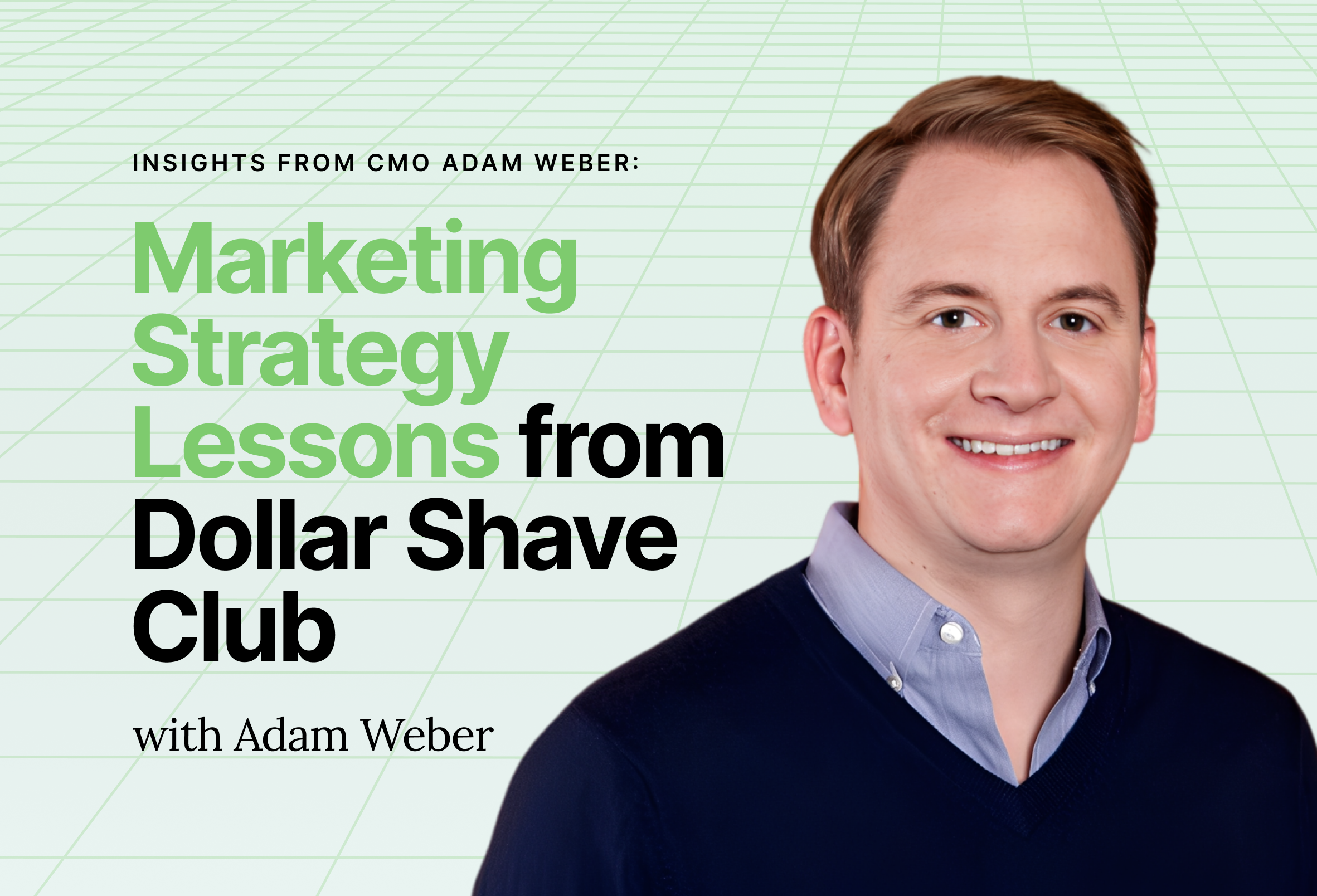






Dollar Shave Club's marketing strategy started with storytelling and mass awareness, not with Facebook ads. The team launched on podcasts, radio, and TV, built an in-house creative team, then layered paid social on top. Unilever acquired the company in 2016 in a deal valued at about $1 billion.
In this masterclass, Adam Weber, Dollar Shave Club's founding CMO, walked through those decisions with Jesse Pujji, founder of GrowthAssistant and founder and CEO of the venture studio Gateway X. Jesse's first company, Ampush, ran Dollar Shave Club's Facebook acquisition for several years, growing spend from about $50,000 a month to $2 million to $3 million a month before the team brought it in-house.
Here are Adam's lessons on brand, performance, retention, team building, and career growth. You can watch the full session on this page.
Key Takeaways
- Start where you can tell your story: Dollar Shave Club launched on audio and TV before paid social.
- Respect the lag: give offline channels at least three months, and judge them on their long-tail effect.
- Awareness is the hardest part of scale: every step up in reach brought new growth.
- Put brand and performance in the same room: separate teams that toss work over the wall fail.
- Grow acquisition by extending LTV: more lifetime value means more room to spend.
- Stay lean: invest in-house in what is proprietary, and use partners for expertise and scalable execution.
Adam Weber's Career: From P&G to Dollar Shave Club
Adam spent his first seven years at Procter & Gamble in brand management, a role that combined positioning, go-to-market, product, and running a P&L. He then spent a year at Gilt Groupe, the flash-sale e-commerce pioneer, before joining Dollar Shave Club right as it raised its Series A.
After the acquisition, he moved home to Cincinnati. He spent five years at Nerdy, an online tutoring marketplace that roughly tripled and went public during his time there. At the time of the session, he had just joined Hungryroot, an online grocery company that personalizes food to health goals and preferences.
What each stop taught him
- P&G taught him to write. New marketers attend a week-long writing boot camp that teaches a concise structure: cut extra words, make a clear recommendation, and back it up. Adam still follows it almost 20 years later.
- Early networks matter. The people you meet at your first company show up again throughout your career.
- Gilt taught him how much he didn't know. In one year he learned what P&G hadn't taught him: personalization, merchandising, direct response advertising, and attribution.
How he landed the job
Adam didn't know Dollar Shave Club founder Mike Dubin or anyone who did. After seeing the launch video, he sent Mike a short cold email explaining exactly why he was the right person for the job. Mike replied within five minutes.
His lesson: put yourself out there, and treat your own pitch like good marketing, with a strong subject line and clear message.
Why Dollar Shave Club Started With TV, Radio, and Podcasts
Today most brands start with Meta. Dollar Shave Club did the opposite, for three reasons:
- The model only worked at scale. Selling a low-cost razor subscription required millions of customers, not thousands, so the team needed mass reach fast.
- A clean slate made measurement easier. Launching offline first made the impact of those channels clear. Brands that add TV after years on Meta struggle to isolate its effect.
- The story needed room. Mike wanted more canvas to tell the brand story than a social feed allowed, and audio scripts plus an existing video made it fast to start.
Ampush then filled in paid social on top of that foundation.
How to make offline channels work
Adam's advice is to be patient and "respect the drag." Give TV or audio at least three months before judging it, and expect a healthier upper and middle funnel that pays off in lower-funnel channels over time.
The Super Bowl was the clearest example. After Dollar Shave Club's ad, almost every acquisition metric improved for about four months: click-through rates rose, CPMs fell, and conversion rates went up.
By then the brand had spent roughly $100 million on media across channels, yet awareness still had room to grow. Adam's conclusion is that awareness, not channel saturation, is the hardest problem in scaling a consumer brand.
Jesse summed up the mindset: think of channels as six-month investments, not one-month tests. Adam agreed that measurement, creative, and budget tolerance all need that longer lens.
How to Balance Brand and Performance Marketing
Adam is unusual because he is both a brand marketer and a performance marketer. He says that combination is rare below the C-suite, so he hires people who are strong on one side and then stretches them toward the other.
Dollar Shave Club's first performance marketer was a purely analytical buyer who cared little about creative. Over time he became a storyteller who builds brands through the same platforms.
The structural rule is simple: put brand and performance people in every meeting together. Separate functions that toss work over the wall will fail.
Dollar Shave Club also built its own internal creative department early, because brand and creative had to be right for every channel to work. For practical channel guidance, see our guide to social media ads.
What Still Applies to DTC Brands Today
- Still true, and more than ever: brand, creative, and storytelling win. The days of media arbitrage and hacks are over.
- No longer true: growth at all costs. Dollar Shave Club's customer economics were aggressive. Today brands need to balance growth with profitability.
Channels Adam likes
- Endorsement audio and influencers: you borrow the credibility of the person talking about you. It is often an easier step up-funnel than producing a great TV spot.
- TikTok: at the time of the session, Adam and Jesse both felt attention there was still underpriced relative to more mature channels.
To build creator programs that drive sales, see our guide to influencer marketing campaigns that convert.
Why Retention Is the Fastest Way to Grow
Customer acquisition tends to drown out retention work. Adam pushes back: "The fastest way to grow customer acquisition is to extend LTV." Higher lifetime value gives you more room to spend while staying profitable.
At Dollar Shave Club, his role covered CRM and retention as well as expanding the product line to raise average order value and lifetime value. Improving LTV often requires close work with product and customer service teams.
To decide where to focus, Adam weighs impact against effort. Jesse's teams use the ICE framework: impact, confidence, and ease.
Marketing Attribution Without a Silver Bullet
Adam was using the word "triangulation" for attribution a decade ago, and he says it is even more complex now. No single method is perfect, so use each for what it does best:
- Media mix models show channel impact over months and quarters.
- Post-purchase surveys give faster directional signals.
- Multi-touch attribution helps sort out mid-funnel credit.
- Incrementality tests are the easiest to defend internally, because a holdout group shows what would have happened anyway.
Then make a judgment call, check it regularly, and don't let measurement paralyze the team. For a hands-on reporting setup, see our Meta ads reporting guide.
How to Work With Agencies
There is no fixed rule for agency versus in-house. Agencies are often the fastest way to test a channel and bring in pattern recognition, and Adam still uses outside experts even after building teams in-house.
The key is participation. Working with an agency is not outsourcing your thinking. "Garbage in, garbage out": if you don't bring guidance and partnership, the agency can't do its best work. Adam says Dollar Shave Club and Ampush worked well because the two teams operated as one.
For a broader framework, read in-house marketing vs. outsourcing: how to decide.
Building Lean, Effective Marketing Teams
Adam prefers lean teams, because large hierarchies slow decisions and each added person contributes a little less. His model has three parts:
- Overinvest in-house in the hardest, most proprietary work.
- Use expert agency partners where outside specialists are the best at what they do.
- Fill the rest with scalable, quality talent for work that has to get done well.
Adam has used GrowthAssistant for analytics and data work and for CRM campaigns that extend lifetime value. He says it lets a team scale those areas quickly without growing the budget or internal headcount, and without waiting through a three-month hiring cycle.
Our guide on how to build a marketing team on a budget covers this model in more detail.
Career Advice for Marketers
- Start at a company with an apprenticeship culture. Adam would choose a large company like P&G over a tech startup for the first years, because it teaches fundamentals such as leading cross-functional teams.
- Learn to write clearly. Adam recommends Axios's Smart Brevity approach, and Jesse's favorite is The Pyramid Principle: start with the answer, then support it.
- Train both sides of your brain. Adam's advice for a future marketer is to get good at math-based problem solving and to understand the arc of a great short story.
- Pick leaders who respect marketing. In DTC, a CEO who values brand and customer experience makes the CMO role work.
- Match the company stage to what you want. Many career mistakes come from joining a company that is too big and slow, or too small and under-resourced, for how you like to work.
- Expect setbacks. After Dollar Shave Club, Adam joined an online antiques marketplace that struggled because its operations and unit economics didn't work, no matter how good the marketing was. He spent 18 months doing whatever the company needed and doesn't regret it.
For more career lessons from CMOs, see our masterclass on how to become a Chief Marketing Officer.
What B2B Marketers Can Learn From DTC
Adam's view is that the B2B and DTC playbooks have converged. B2B teams can borrow storytelling and social ad creative tactics, while consumer marketers can learn from B2B's precise segmentation and tailored value propositions.
GrowthAssistant places AI-certified marketing specialists who work your hours, with plans starting at $3,500 a month. Book a call to see how a dedicated specialist can help a lean team do more.