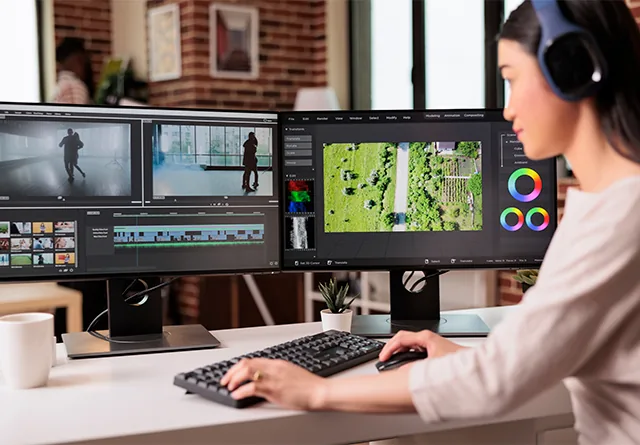



Video editor costs vary by hiring model: Upwork lists US$31–$60 per hour for its mid-tier category, while the U.S. median annual wage for film and video editors was US$75,420 in May 2025, before employer overhead. GrowthAssistant lists typical full-time subscriptions at US$3,500–$4,000 per month, with pricing dependent on seniority and skills.
These are different benchmarks: a global freelance marketplace rate, a U.S. employee wage, and a managed talent subscription. Compare them against your required editing hours, formats, revision rounds, and ongoing workload. This guide explains what each model includes and how to choose between in-house, freelance, and dedicated offshore support.
Video Editor Cost Comparison by Hiring Model
All amounts below are in USD. These benchmarks describe different services, not equivalent offers or guaranteed savings. Sources are linked in the introduction; salary data refers to May 2025, and provider information was checked in October 2026.
In-House Video Editors (US-Based)
What It Actually Costs
Base salary is only part of the picture. Add your actual costs for benefits, employer payroll obligations, equipment, software, recruiting, and management. Do not treat a salary benchmark as the total hiring cost.
U.S. Video Editor Salary Benchmark
BLS reports a median annual wage of US$75,420 for film and video editors in May 2025. This covers the occupation across experience levels and industries; it is not a junior, mid-level, or senior salary band. Compare current offers for the skills and location you need.
When In-House Makes Sense
High volume of strategic video: Teams with a steady workload and close collaboration needs may benefit from an employee who participates in planning, production, and post-production.
Brand and creative ownership: An in-house editor can develop a consistent visual identity across campaigns, especially when storytelling, creative testing, and feedback from internal stakeholders are part of the weekly workflow.
When In-House can be a Challenge
Cost: You’re carrying a full salary and benefits, whether it’s a busy or slow month.
Flexibility: Some teams realistically only need a video editor for certain campaigns or seasons. Full-time hiring creates recurring capacity costs even when your production schedule is quiet.
Freelance Video Editor Rates
What It Actually Costs
Freelance video editing rates vary by specialization, location, and project scope. Upwork’s published categories list entry-level work below US$30/hour, mid-tier work at US$31–$60/hour, and senior work at US$61–$150/hour. These are marketplace categories, not universal experience bands or US-only rates.
Price alone does not establish quality. Compare relevant portfolio samples, the deliverables included, and revision terms. Ask for a project quote when the scope is fixed.
For an illustrative budget, eight agreed editing hours at US$40/hour would cost US$320, before any additional fees or licensed assets. That is a calculation, not a claim about how long a particular video takes to edit.
When Freelancers Make Sense
One-off projects: Teams producing a product launch video or a one-time campaign can use a freelancer for a defined scope. Ongoing retainers can also work when capacity and deadlines are agreed.
Reusable templates: A freelancer can develop editing templates, motion graphics packages, or branded intros for an internal team to reuse. This works well when ongoing production is manageable without a dedicated editor.
When Freelancers can be a Challenge
Reliability: Some freelancers serve several clients. Agree on reserved capacity, turnaround times, and backup arrangements before committing.
Consistency: Review a relevant portfolio and paid sample before a larger commitment. Confirm who reviews quality and how revisions are handled.
Offshore / Nearshore Video Editors
What It Actually Costs
GrowthAssistant provides a full-time, dedicated offshore video editor through a monthly subscription. Its published typical range is US$3,000–$4,000 per month, with higher ranges for some specialist skills. Request a quote for the editing and motion graphics experience you need.
A provider subscription is not a video editor’s take-home salary. The service includes hiring support and HR/admin services. Confirm software, equipment, and any other charges in your quote rather than assuming everything is included.
A US$4,000 monthly subscription totals US$48,000 over 12 months before any excluded costs. Compare that annual fee with the full employer cost of a similarly scoped local role, not with an unverified salary estimate.
When Offshore Makes Sense
Consistent production: Growth-stage teams publishing weekly YouTube videos, short-form social clips, or user-generated content (UGC) ads may benefit from a dedicated editor who learns their brand and production standards. The economics depend on having enough recurring work to use that full-time capacity.
Commitment and capacity: Check the minimum term and cancellation notice. GrowthAssistant’s pricing FAQ specifies a 90-day initial commitment, then month-to-month service with 30 days’ notice. Short seasonal projects may fit a freelancer better.
The Tradeoff
For teams already outsourcing digital marketing, video editing often works best as part of a coordinated production process. Shared briefs, secure footage transfers, review deadlines, working-hour overlap, and clear approval ownership help the editor collaborate with content, paid media, and creative leads.
When to Offshore vs. Nearshore
The distinction between nearshore and offshore outsourcing matters most when a video workflow requires frequent live reviews. Nearshore teams may offer easier time-zone overlap, while offshore editors can also work agreed US hours. Compare actual availability and role-specific quotes rather than assuming one region delivers better quality or pricing.
For example, outsourcing to the Philippines can give US teams access to dedicated creative professionals. English is one of the country's official languages, which can support collaboration on briefs and feedback, although each candidate's communication skills and editing portfolio should still be evaluated individually.
How to Choose the Right Model
The best choice depends on production volume, creative complexity, and how much management time your team can commit. When building a marketing team on a budget, it helps to compare the cost of available editing capacity with the number of videos and revisions you actually need each month.
In-house employment is often appropriate for a steady workload that requires close collaboration and creative strategy. Freelance support suits defined projects, occasional campaigns, or specialist tasks. Dedicated offshore staffing can fit teams with recurring editing needs, a clear internal creative owner, and enough production volume to justify full-time capacity.
A useful editing brief specifies raw-footage volume, final video lengths, aspect ratios, versions, captions, motion graphics, music licensing, turnaround time, revision rounds, and source-file handoff. Those details also make a dedicated video editor versus freelancer comparison more meaningful, because both options can be evaluated against the same deliverables.
GrowthAssistant: How It Works
GrowthAssistant places full-time, dedicated marketing and design talent with growth-stage companies. Every Growth Assistant works your hours, in your tools, exclusively for you. They join your standups, learn your brand, and integrate into your team the same way a local hire would.
Our vetting and support model includes role-specific screening, AI certification, a dedicated Success Manager, and a 100% Match Guarantee.
Clients include HubSpot, DoorDash, SoFi, Dr. Squatch, Calm, and Harry's.
For teams ready to add consistent video production capacity, GrowthAssistant can help identify a dedicated editor with the right experience in short-form content, YouTube, paid social creative, or motion graphics. The final quote should clarify the monthly fee, included services, initial commitment, and cancellation terms.