





The right marketing team structure depends on your stage, budget, and primary growth channel. Most teams sit under one marketing leader with three branches: demand generation, content and brand, and marketing operations.
Early teams combine them into one or two generalists; larger teams split them into specialist pods.
How you staff those functions, and whether you hire full-time, contract, or outsource each one, is the actual decision you're making when you "build a marketing team."
This guide walks through the three stages of marketing team structure, the models and org chart patterns that hold up as you scale, the core roles and what they cost, six concrete team examples, and the mistakes that create the most rework later.
The Three Stages of Marketing Team Structure
Marketing team structure isn't static. The right shape at 10 employees becomes the wrong shape at 100. Most growing companies move through three broad stages, defined primarily by funding stage and revenue rather than headcount alone.
Each stage below also notes the rough employee-count range it tends to map to, since that's the number most people have on hand when sizing a team.
Stage 1: Early Stage (Pre-Seed to Seed, Usually 1-3 Marketers)
At this stage, marketing is generalist by necessity. You likely have one marketing lead, sometimes the founder, wearing every hat: content, paid, email, social, brand. That's usually a digital marketer in practice, even if the title on the door says something else.
The org chart is flat because there's no org yet—just a person or two figuring out which channels actually work. In headcount terms, this stage usually lines up with companies in the 1 to 10 employee range, before any formal marketing structure exists.
This early phase is typically when companies start searching for how to build a marketing team on a budget.
The structural priority here isn't specialization. It's finding your first repeatable channel and getting a second generalist or a contractor in to help you run it consistently.
Stage 2: Growth Stage (Series A/B, Usually 4-15 Marketers)
This is where structure starts to matter. You've found a channel or two that work, and generalists start to become a bottleneck.
This stage typically splits into functional pods: demand generation, content and brand, and marketing operations, each with a lead who reports to a Head of Marketing or VP of Marketing. In headcount terms, this stage usually maps to companies in the 11-50 employee range.
This is also the stage where most teams first ask whether to hire full-time specialists in-house or bring in dedicated talent through an outsourcing or staffing partner.
Both can work. The wrong move is understaffing execution while your strategic hires spend their week doing entry-level tasks instead of running the function they were hired to lead.
This is often the point where a marketing account coordinator pays for itself: one person who owns timelines, stakeholder communication, and reporting, so your functional leads can stay focused on strategy.
Stage 3: Scale Stage (Series C+ or $20M+ Revenue, 15+ Marketers)
At scale, functional pods split further into channel-specific roles, and you likely add a layer of management between individual contributors and the CMO or VP of Marketing.
In headcount terms, this stage usually starts around 51-200 employees, when a management layer (leads or a Director of Marketing) first appears between individual contributors and the Head of Marketing or VP.
Past roughly 200 employees, marketing typically reports to a CMO outright, with directors owning each major function, managers owning sub-functions, and individual contributors specialized down to a single channel or even a single stage of the funnel.
Structure here is less about "who does what" and more about clean handoffs: how content briefs move from strategy to production, how paid and lifecycle coordinate on offers, how data flows back to the people making budget calls.
The risk at this stage isn't understaffing. It's structural bloat: too many managers, too few people actually executing, and reporting lines that made sense for the last stage but not this one.
These headcount ranges are directional, not rules. A capital-efficient 60-person company can run a lean 3-person marketing team well past the point this framing suggests, and a well-funded 20-person startup can justify a larger team earlier. Use headcount as a quick cross-check, not the deciding factor.
Marketing Department Structure: A Simple Org Chart to Start From
Regardless of stage, most marketing org charts resolve into three reporting branches under a single marketing leader (Head of Marketing, VP of Marketing, or CMO, depending on size):
- Demand Generation: paid media, SEO, lifecycle/email, and (in B2B) demand gen or growth marketing, all pointed at pipeline or traffic. For a closer look at cross-channel experimentation and ownership, see what a growth marketer does.
- Content & Brand: content marketing, social media, design, and brand strategy, all pointed at awareness and audience
- Marketing Operations & Analytics: martech stack, campaign QA, reporting, and attribution — often filled by a dedicated marketing data analyst once it outgrows a side-of-desk job — pointed at making the other two branches measurable. Learn more about what a marketing analyst does and how the role supports decisions
Small teams collapse these branches into one or two generalists. Larger teams split each branch into its own pod with a lead.
Either way, this three-branch shape is a useful default when you're sketching your first real org chart, because it forces you to assign an owner to measurement (marketing ops) instead of leaving it as everyone's job and no one's job.
Three Marketing Team Structure Models
Company stage tells you roughly how many people you need. It doesn't tell you how to organize them. Regardless of stage, most marketing teams end up shaped by one of three underlying models, and the model matters as much as headcount for how clean the structure feels day to day.
Model 1: The Functional Model
This is the default shown above: one marketing leader, three functional branches (demand generation, content and brand, marketing operations), each staffed by specialists or generalists depending on size.
It's the easiest model to explain to a board or a new hire, and it works well until channels start requiring genuinely cross-functional coordination, a paid campaign that needs its own landing page, creative, and analytics all moving together, for example.
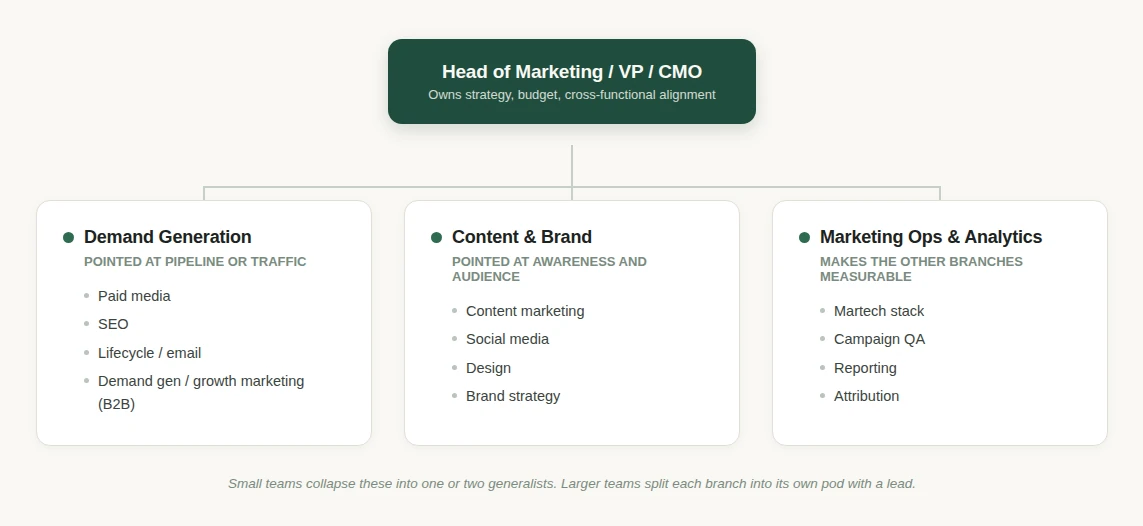
Text version: Head of Marketing → Demand Generation (paid media, SEO, lifecycle/email, growth marketing), Content & Brand (content marketing, social media, design, brand strategy), Marketing Operations & Analytics (martech stack, campaign QA, reporting, attribution).
Model 2: The Pod / Channel-Owner Model
Instead of splitting by broad function, this model organizes around channel-owning pods: small cross-functional teams that own a channel end to end.
A paid pod might include a paid specialist, a designer, and an analyst who all answer to a pod lead rather than to three separate functional managers. This model trades some specialization depth for faster execution, since a pod doesn't need to hand work across departments to ship a campaign.
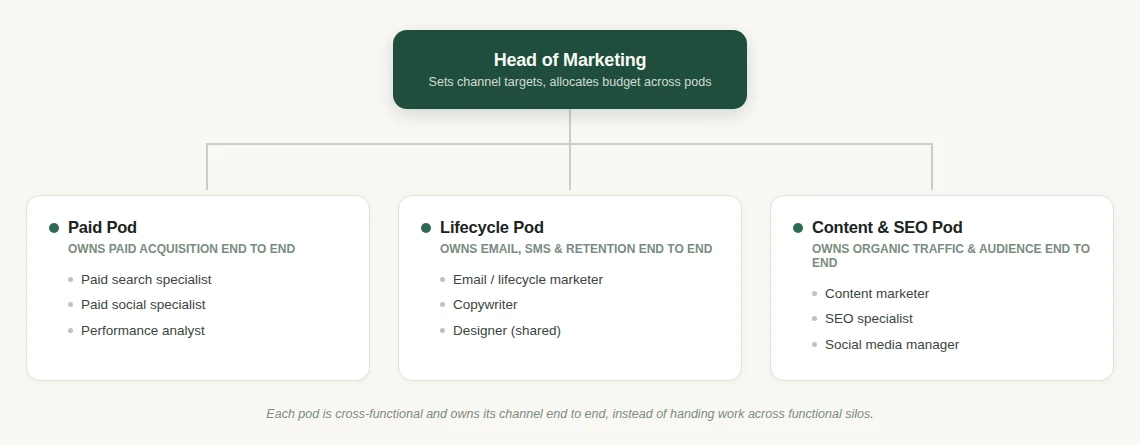
Text version: Head of Marketing → Paid Pod, Lifecycle Pod, Content & SEO Pod, each a small cross-functional team led by a pod lead rather than a functional manager.
Model 3: The Hybrid In-House + Outsourced Model
Here, strategic ownership stays in-house (a Head of Marketing and one or two functional leads), while specialist execution roles are filled by full-time talent embedded through a staffing partner rather than hired locally and full-time from day one.
It's less a distinct org shape than a staffing decision layered onto whichever model above you choose, and it's the model most of the growing teams we work with land on once they've validated a channel and need dedicated execution without a three-month local hiring cycle.
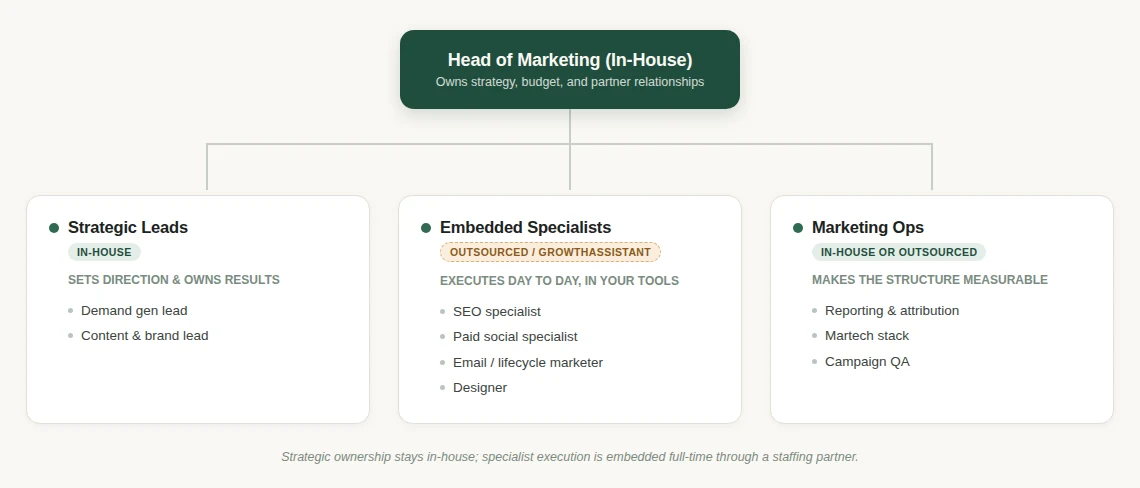
Text version: in-house strategic leads (Head of Marketing, functional leads) own direction; outsourced embedded specialists, sourced through a staffing partner, own execution within each branch.
Most teams don't pick one model forever. It's common to run the Functional Model early, shift toward the Pod Model as specific channels scale, and layer the Hybrid Model's staffing approach on top of either one once budget allows.
Where AI Changes the Headcount Math
The models above answer who reports to whom. They don't answer a question most growth leaders are now asking before any of that: how many of these roles need to be a dedicated full-time person, versus one specialist using AI tools well?
That's a live structural question in 2026, not a hypothetical one. A specialist with a solid AI workflow for research, drafting, QA, and reporting can reasonably cover more ground than the same role could two years ago.
That doesn't eliminate the branches in the org charts above — demand gen, content and brand, and marketing ops still need an accountable owner each.
It does change how many people sit under each branch, and how much of what used to require two or three hires can sit with one well-equipped specialist instead.
This is also why AI fluency, not just channel expertise, belongs in how you evaluate a hire or a staffing partner for any of these roles.
Every GrowthAssistant specialist we place completes role-specific AI training and certification before starting, specifically so a single specialist can cover more of a function's workflow without quietly becoming the understaffed-execution problem described in Stage 2 above.
Marketing Team Roles and Responsibilities
"Marketing team roles and responsibilities" tends to get vague fast, so here's a practical breakdown of the roles that show up most often, and who typically owns what.
Not every team needs a dedicated person in every box on day one. Early-stage teams combine several of these into one generalist role.
What matters is that someone, even if it's a fractional or outsourced specialist, is explicitly accountable for each function. An unassigned function doesn't disappear. It just quietly stops getting done.
Marketing Role Salaries in the US
Knowing what a role costs is part of deciding whether to hire it, and when. The ranges below are 2026 US national averages pulled from public salary-benchmarking sources; actual pay varies by city, company stage, and whether equity or bonus is part of the package.
- Head of Marketing / VP / CMO: $150,000–$300,000+ base; total comp often $220,000+ with bonus and equity at the CMO level (Source: Built In)
- Marketing Director: $76,000–$134,000 base ($104,000–$185,000 total pay) (Source: Glassdoor)
- Demand Gen Manager / Growth Marketer: $69,000–$115,000 base ($89,000–$152,000 total pay) (Source: Glassdoor)
- Product Marketing Manager: ~$120,000 average base (~$135,000 average total comp) (Source: Built In)
- Content Marketing Manager: ~$89,000 average base (~$102,000 average total comp) (Source: Built In)
- Social Media Manager: ~$75,000 average base (~$94,000 average total comp) (Source: Built In)
- SEO Specialist: $57,000–$98,000 base ($66,000–$115,000 total pay) (Source: Glassdoor)
- Paid Social Specialist: $51,000–$75,000 base ($53,000–$81,000 total pay) (Source: Glassdoor)
- Email / Lifecycle Marketing Specialist: $50,000–$84,000 base ($58,000–$98,000 total pay) (Source: Glassdoor)
- Marketing Operations Analyst: $49,500–$90,000 (average ~$64,000) (Source: ZipRecruiter)
- Creative / Graphic Designer (marketing-focused): $41,000–$74,000 base (~$54,000 average) (Source: PayScale, re-verified 2026-10-02)
These are directional benchmarks for budgeting, not a quote for any specific hire. The same role can cost substantially more in a major metro than in a lower cost-of-living market, and more at an established company than at an early-stage startup.
US Salary vs. GrowthAssistant Cost, by Role
GrowthAssistant is a staffing partner, not a salary-benchmarking site, so here's the comparison we're positioned to make honestly: what a full-time offshore specialist through GrowthAssistant costs against the US averages above, for the four specialist roles covered below.
| Role | US Base Salary (annual) | GrowthAssistant (annual, full-time) |
|---|---|---|
| SEO Specialist | $57,000–$98,000 | From $42,000 ($3,500/mo) |
| Paid Social Specialist | $51,000–$75,000 | $36,000–$48,000 ($3K–$4K/mo) |
| Email / Lifecycle Marketing Specialist | $50,000–$84,000 | $36,000–$48,000 ($3K–$4K/mo) |
| Creative / Graphic Designer | $41,000–$74,000 | From $42,000 ($3,500/mo) |
GrowthAssistant figures are current starting rates for a full-time, AI-certified specialist, checked directly against our own role pages on 2026-10-02; they are not a quote for any specific hire and can vary with role tier. US figures use the same Glassdoor/PayScale sources cited above.
Meet the Roles: What These Marketing Specialists Actually Do
Job titles only say so much. Here's what four of the most commonly outsourced marketing roles look like in practice, illustrated by real GrowthAssistant specialists.
To budget for that capacity, compare graphic designer costs across in-house, freelance, and offshore models, including employer costs and the monthly workload that justifies a dedicated hire.
Designer
A marketing designer builds the visual assets every other function depends on: ad creative, landing pages, social graphics, and brand-consistent templates.
The job is measured in performance as much as polish, since campaigns stall without fresh, working creative. Pryce, a GrowthAssistant creative strategist, is a documented example: “I took a client’s CPC from $65 to $14. Then helped a hair care brand move 100K units in 4 months.”
Email Marketing Specialist
An email marketing specialist owns lifecycle revenue: flows, segmentation, list health, and testing subject lines and send times.
It's one of the highest-leverage owned channels on this list, since it's largely under the team's control rather than dependent on a platform's algorithm or ad auction.
When Ode à la Rose, a premium floral brand, replaced its email agency with one full-time GrowthAssistant specialist, newsletter and campaign revenue jumped 29% year over year and feedback rounds got 25–50% faster.
Paid Social Specialist
A paid social specialist runs the acquisition engine on Meta, TikTok, and other paid social platforms: targeting, creative testing, budget pacing, and scaling what's working while cutting what isn't.
It's a role where AI-assisted creative testing has changed the day-to-day most: reviewing ad performance, generating creative variants, and flagging what to scale no longer takes a second hire just to keep pace with a single account.
SEO Specialist
An SEO specialist owns organic search visibility. Keyword research, on-page optimization, technical site health, and content built around real search intent. It's a slower-compounding channel than paid, but one that keeps producing traffic without ongoing spend.
GrowthAssistant's SEO specialists run that process day to day with tools like Semrush, Google Search Console, and Ahrefs, AI-certified to use them for faster research and QA rather than to replace the judgment calls the role still requires.
These four roles map directly onto the Demand Generation and Content & Brand branches described above, and are among the roles most often filled through a staffing partner rather than hired locally and full-time from day one.
How to Create a Marketing Team Structure (With 6 Examples)
Building a team structure comes down to answering three questions for each function you need: who leads it, what sits under them, and who they report to. Here's how that plays out across six of the most common marketing team types.
1. Social Media Team
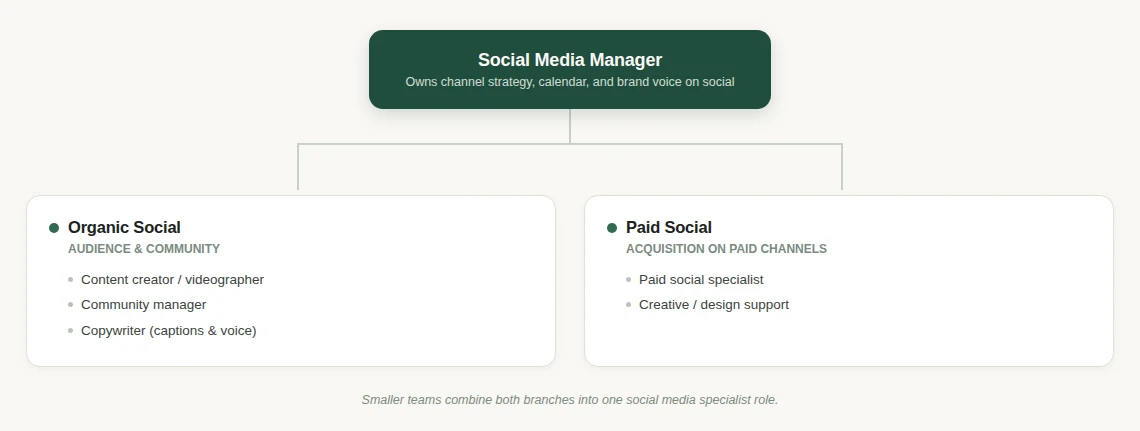
A social media team usually splits into organic (audience and community) and paid (acquisition), reporting to a Social Media Manager who owns channel strategy and brand voice.
Smaller teams run both branches through one social media specialist; larger teams add a dedicated paid social hire once organic and paid start competing for the same person's time.
2. SEO Team
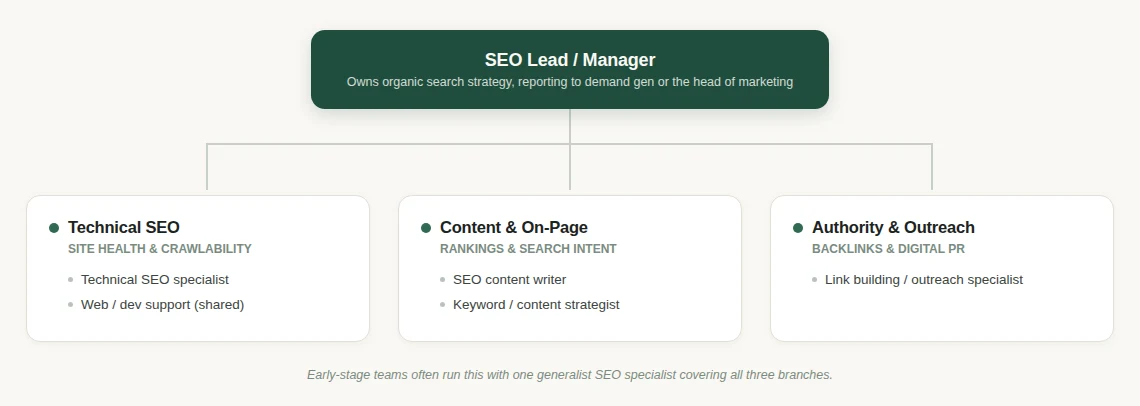
An SEO team typically covers three branches: technical SEO (site health), content and on-page (rankings and search intent), and authority/outreach (backlinks and digital PR).
One generalist SEO specialist can run all three at an early stage; each branch becomes its own hire once search is a primary growth channel.
3. Content Team
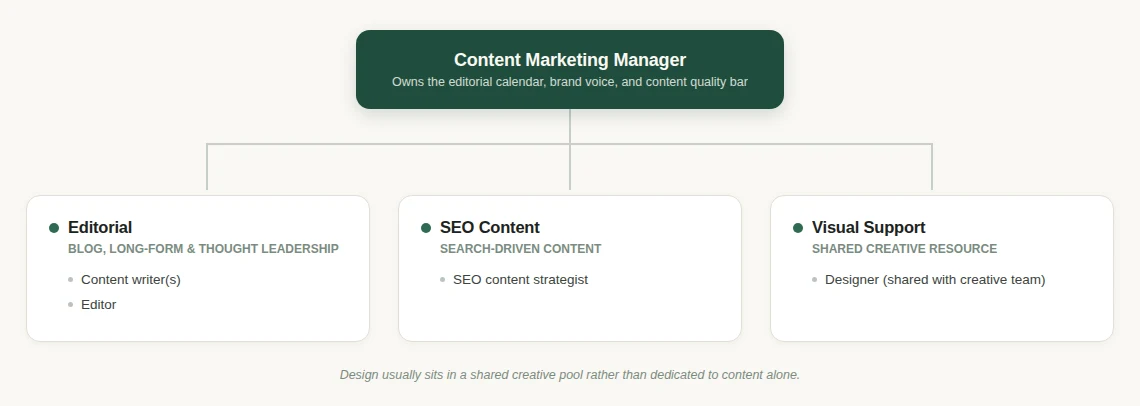
A content team is organized around the editorial calendar: writers and an editor producing long-form and blog content, an SEO content strategist making sure it's built to rank, and a shared designer providing visual support.
Content teams rarely own a dedicated designer; that resource is usually shared with the creative team.
4. Creative Team
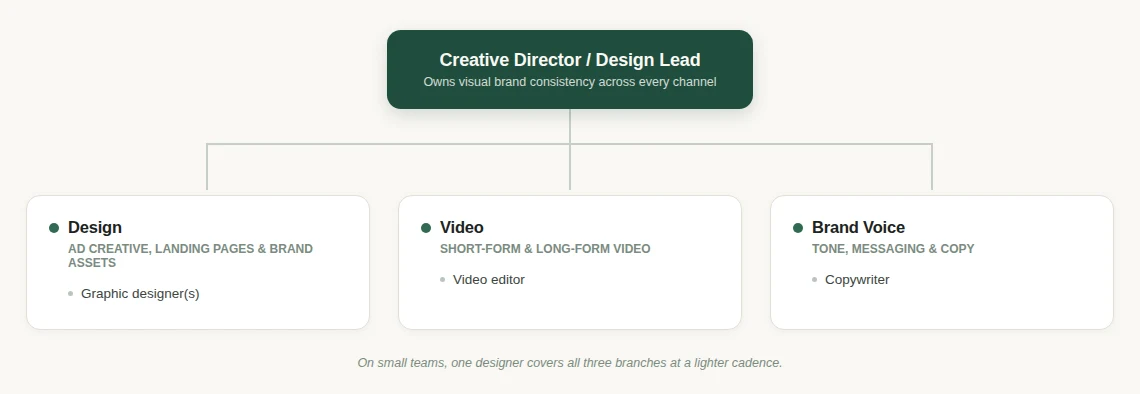
A creative team splits into design (ad creative, landing pages, brand assets), video, and brand voice/copy, reporting to a Creative Director or Design Lead who owns visual consistency across every channel.
On a small team, one designer covers all three branches at a lighter cadence rather than each becoming a dedicated hire.
5. Product Marketing Team
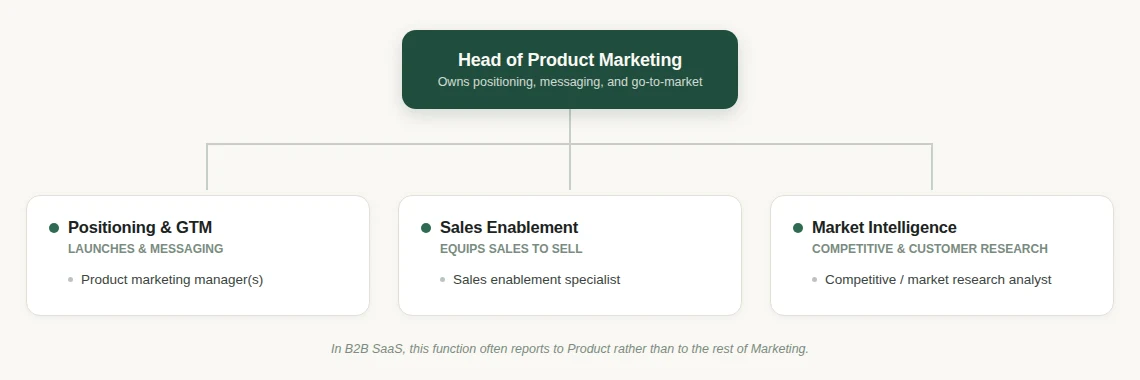
A product marketing team owns positioning, messaging, and go-to-market for product launches, sales enablement content that equips the sales team to sell, and competitive or customer research that feeds both.
In B2B SaaS, this function often reports into Product rather than the rest of Marketing, since it sits closest to the roadmap.
6. Media Team
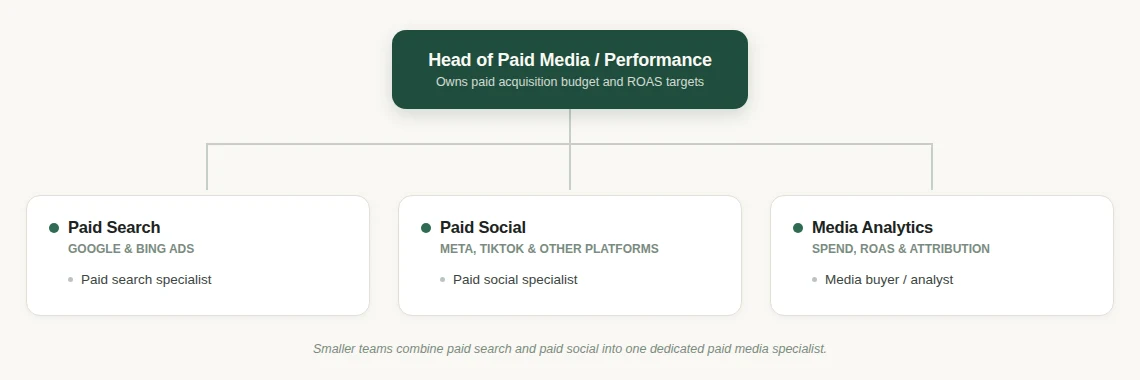
A media, or performance marketing, team owns paid acquisition budget and ROAS targets across paid search and paid social, with a media buyer or analyst tracking spend and attribution across both.
Smaller teams combine paid search and paid social into a single dedicated paid media specialist rather than splitting the two.
Marketing Team Structure by Primary Growth Channel
The channel that drives most of your growth should shape who you hire first, not just how many people you hire. A few common patterns:
- Primarily SEO/content-driven: Prioritize a content marketer and SEO specialist early; paid and social can stay minimal or outsourced until organic is established.
- Primarily paid-driven: Prioritize a paid media specialist and a designer who can keep pace with creative testing; organic content can be a later hire once paid economics are proven.
- Primarily lifecycle/retention-driven (common in ecommerce): Prioritize an email/lifecycle marketer early, since retention economics compound faster than most acquisition channels on a limited budget. This is also where an ecommerce operations specialist often picks up lifecycle work alongside broader store operations.
- Primarily outbound/sales-led (common in B2B): Prioritize a demand gen marketer and a product marketer who can arm sales with content and messaging, ahead of broad brand or organic investment.
Whichever channel is primary, the three-branch structure and the models above still apply. The difference is sequencing: staff the branch tied to your primary channel first, and treat the others as supporting functions until they need to become their own hires.
In-House, Outsourced, or Both: Structuring Around the Talent You Actually Have
Org charts assume you can hire whoever the chart says you need. In practice, most growing teams are structuring around a mix: a few in-house strategic hires, plus specialist execution that's contracted, agency-run, or staffed through a partner like GrowthAssistant.
This isn't a compromise structure. It's often the right one. A Head of Marketing who owns strategy doesn't need to also be the person building UTM-tagged campaigns in an ESP.
Pairing a strategic in-house hire with a dedicated, full-time specialist for execution, whether that specialist sits in-house or is embedded through a staffing partner, tends to produce a cleaner org chart than trying to hire every function locally and full-time before you can actually afford to keep them busy.
We've written a full breakdown of when to keep marketing in-house versus when to outsource it, including the tradeoffs on cost, control, and ramp time: In-House vs. Outsourcing Marketing: How to Decide.
Common Marketing Team Structure Mistakes
- Hiring generalists past the point where you need specialists. A generalist who got you from zero to your first channel is rarely the person who scales that channel. Recognize the handoff point before it becomes a bottleneck.
- No named owner for marketing operations. Reporting and attribution end up split across three people's side projects, and nobody trusts the dashboard.
- Building the org chart around resumes instead of functions. Structure should follow what the business needs done, not what your current team happens to be good at.
- Adding management layers before adding execution capacity. A team with more leads than doers looks impressive on a chart and produces less work.
- Treating structure as permanent. The right shape at 10 people is the wrong shape at 50. Revisit your structure at each funding or revenue milestone, not just when something breaks.
How GrowthAssistant Fits Into Your Structure
Most of the growing teams we work with aren't short on strategy. They're short on reliable execution for the specialist roles their org chart calls for: SEO, paid social, email, content, marketing ops, and more.
GrowthAssistant places full-time, AI-certified marketing talent that plugs directly into a role on your org chart, working your hours, in your tools, exclusively for you.
Every placement comes with a 100% lifetime match guarantee and month-to-month terms with no cancellation fees, and a dedicated success manager who stays involved after day one.
If your structure calls for a specialist you don't want to spend three months and a recruiter fee finding, that's the gap we're built to fill.
Clients include HubSpot, DoorDash, Dr. Squatch, SoFi, Calm, Harry's, Talkspace, and quip. Starting at $3,500/month, month to month, no placement fee.


.svg)