

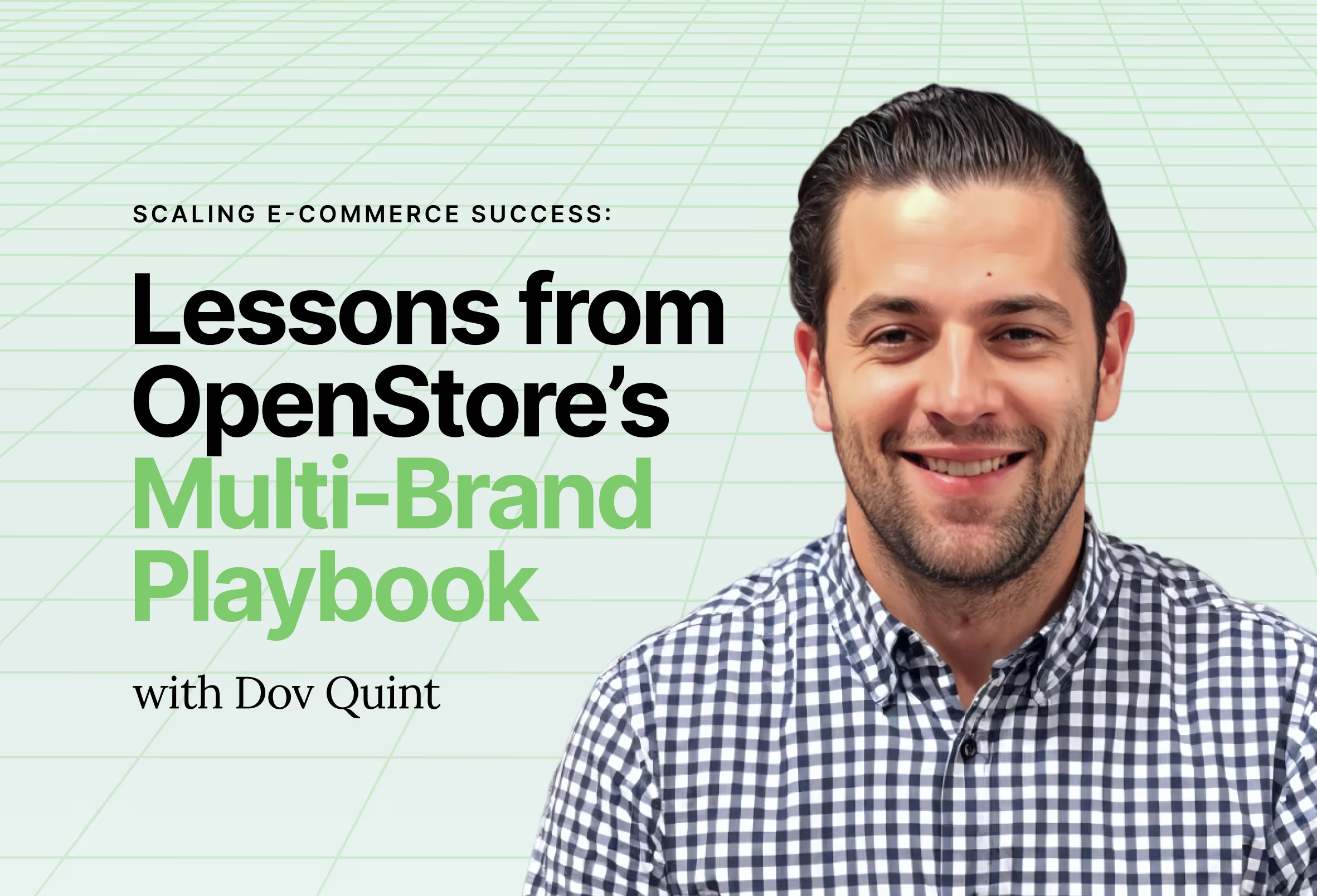






Scaling an ecommerce business profitably comes down to three levers: disciplined experimentation, expanding into channels the founder never tested, and better gross margins through supply chain scale. That is the playbook OpenStore used to grow Jack Archer, a men's pants brand, more than 10x after acquiring it.
Dov Quint, who led the storefronts team at OpenStore, walked through it with GrowthAssistant founder Jesse Pujji in this July 2025 session. At the time, OpenStore ran close to 50 Shopify brands. Before joining, Dov spent close to a decade running a family ecommerce business. You can watch the full session on this page.
Update: In August 2025, a few weeks after this conversation, OpenStore was reportedly shutting down more than 40 of its Shopify stores to focus solely on Jack Archer, according to PYMNTS, citing CNBC. The lessons below describe how the portfolio operated at the time of the recording.
Key Takeaways
- Be profitable on the first order: healthy unit economics come before scale.
- Test prices, not only discounts: a higher price can raise gross profit even if conversion dips slightly.
- Standardize, but test it first: OpenStore moved acquired brands to its own theme only after testing it against the original.
- Add the channels the founder didn't: Google paid search grew from almost nothing to close to 40% of Jack Archer's sales.
- Watch gross profit per visitor: it combines conversion, average order value, and margin into one storefront number.
- Segment before you react: an aggregate conversion rate hides what is really happening.
Running One Brand vs. 50
The single brands Dov has seen do well usually have a founder or leadership team that obsesses over every detail: the storefront, the unboxing, and the post-purchase experience.
Running many brands means keeping that obsession without growing headcount and costs in a straight line with every brand you add. Dov called finding that middle ground the key to making OpenStore's model work.
How the Ecommerce Market Changed After COVID
- The boom: COVID packed more than a decade of ecommerce growth into about a year, which set unrealistic expectations for how fast a brand could grow.
- The hangover: supply chain problems followed, and ad platforms became crowded and expensive as many new brands launched quickly.
- The reality check: for many brands, the level of investment no longer matched the level of performance.
Dov said OpenStore was not trying to buy distressed brands. It looked for brands that had found product-market fit and offered their founders a liquidity event. He knew from his own experience that founders treat their brands like a baby, and want to sell to someone who will take care of it.
What OpenStore Looked For in a Brand
At the time of the session, OpenStore's buy box was simple:
- $250,000 to $2 million in profitable revenue, although it would look at larger brands.
- Most sales on Shopify, direct to consumer. Some Amazon or retail sales were acceptable.
- Product categories that aren't restricted on Facebook advertising.
- Growth with healthy margins, plus a clear path to the next level.
The diligence process was designed to be fast. Founders connected their Shopify and ad accounts, uploaded a P&L, and could receive a non-binding offer within a couple of days, with no broker fees. Dov contrasted that with acquisition processes that can take six months to a year.
OpenStore tried paid ads to find sellers, but community events worked better, because founders want to sell to a buyer they trust.
It also stayed focused on Shopify businesses. Running one brand is hard, Dov said, and stretching into wholesale-driven or retail-driven models outside the team's expertise would have spread it too thin.
Case Study: How OpenStore Grew Jack Archer More Than 10x
Jack Archer founder Miguel launched the brand in 2022 after reading Reddit threads where men complained about the fit and quality of pants from established brands. He found product-market fit quickly, then sold to OpenStore so he could move on to other projects.
Over the next two-plus years, OpenStore grew the brand more than 10x using three levers that make up its playbook.
1. Experimentation
The quantitative tests covered pricing, free shipping thresholds, and shipping costs. The surprise was pricing. Raising prices did not cut conversion enough to offset the extra gross profit.
Dov's illustration: if you move a $79 product to $89, you may convert slightly fewer visitors, but you earn $10 more on every order. The test is whether total gross profit goes up.
The qualitative side was conversion rate optimization, including landing pages built to support the paid media team. For a framework you can apply to your own store, see our conversion rate optimization guide.
2. Scaling marketing and testing new channels
Miguel had grown the brand almost entirely on Meta. OpenStore scaled Meta further, then built Google paid search from almost nothing to what Dov estimated was close to 40% of sales.
Jesse pointed out that product listing ads were an obvious fit for a catalog of pants. Dov credited capital, an expert team of media buyers, and learnings shared across dozens of brands. CRM optimization was another focus. To get more from shopping feeds, see our guide to product listing optimization.
3. Gross margin improvements
Portfolio volume gave OpenStore leverage with suppliers. The portfolio held more than 100,000 SKUs, and most brands shipped from one main US third-party logistics partner, which gave it room to optimize storage and fulfillment costs. Scale also brought better pricing from app providers.
The First 60 Days After an Acquisition
OpenStore's first step with a new brand was standardization, but not for its own sake. The team moved each store to its standard Shopify theme and tech stack, and first tested the new theme against the merchant's theme to make sure performance didn't drop.
Most of the portfolio ran on the same theme and app stack, with exceptions where a business needed them. The five or six subscription brands, for example, needed a subscription app.
After that came experimentation. Over time the team built a CRO playbook of changes that, once proven on a couple of brands, reliably improved the experience across categories. For more on theme work, read our Shopify theme customization guide.
Functional Teams Instead of Brand Pods
OpenStore ran a flat structure built around functions: storefronts, marketing, supply chain, and customer experience. Each team was made up of specialists in its discipline.
The company had tried pods that each owned specific brands. People became so focused on their own brands that it was harder to share learnings across the company. Functional teams can apply a win from one brand to the rest of the portfolio.
Lessons From Running Dozens of Stores
Automate big events
On Dov's first Black Friday, OpenStore owned about 35 stores. His team, with help from its Growth Assistants, updated creative, hero banners, and ribbons by hand, store by store, starting at midnight.
The company then built tools to create discounts and schedule every storefront change in advance.
Segment your analytics before reacting
When marketing performance softened between July 4 and Prime Day, it was tempting to assume something on the sites was broken. Dov's rule is to break conversion down by traffic source, new versus returning visitors, and other segments before drawing conclusions. Wrong assumptions lead to wrong fixes.
The Metrics That Matter
Contribution profit
For the business, contribution profit is the number one metric, not top-line sales. Start with sales, subtract returns, cost of goods, marketing, credit card fees, and other variable costs, and track the result daily.
For contribution margin, Dov called 20% or more an excellent, high bar to aim for.
Gross profit per visitor
For the storefront, Dov's north star is gross profit per visitor. Conversion rate, average order value, and bounce rate are supporting metrics.
Gross profit per visitor captures what those metrics miss. Raising a free shipping threshold, changing prices, or upselling a product with a different margin all change the sales mix, and this one number shows whether the change made money. Jesse added that giving a team one clear north star metric helps everyone find ways to improve it.
To set up reporting around these numbers, see our guide on how to build a marketing dashboard.
Advice for Ecommerce Founders
- Be profitable on the first order. The days of raising capital on a pitch deck and buying growth are over. Jesse pointed to profitable brands such as Simple Modern and Ridge as models.
- Build a product people love. Repeat purchases and word of mouth lower your dependence on what Dov called the "Meta tax."
- Know the subscription exception. If you can prove retention over six to nine months, first-order profitability matters less.
- Research before you launch. Use Google Trends, industry newsletters, and a review of the competitive landscape, then check whether the economics work.
- Skip custom apps and development early. No upsell app will save a business that doesn't work. Many features are now built into Shopify themes, and Dov wouldn't focus on these optimizations until a brand reaches at least a couple of million dollars in sales.
- Consider crowdfunding to test demand. A successful campaign gives you a built-in community of early believers.
- Know what you want if you sell. Be honest with yourself about your goals before starting any sale process.
For a closer look at valuation and deal terms, see our masterclass on how to sell a marketing agency.
For apparel, OpenStore relied mainly on paid ads for new products, supported by Gumdrop, an internal tool that let influencers opt in to receive products. Dov also called existing customers the best source of honest feedback.
How OpenStore Used AI
OpenStore built its own AI tools for customer experience, which Dov said automated 60% to 70% of inbound customer messages. Up to 40% of its employees were technical, including engineers, data scientists, and analysts, so the company built tools whenever it saw a better way than what already existed.
How OpenStore Worked With GrowthAssistant
OpenStore worked with GrowthAssistant almost from its start, growing from one Growth Assistant to an entire team across functions:
- Shopify development: onboarding new brands, building themes to test against the merchant's theme, configuring apps from SOPs, and editing Liquid code and CSS. Dov said they asked questions and challenged decisions to understand the business.
- Design: working with OpenStore's internal designers to build pages and improve the user experience.
- Marketing: handling the manual parts of producing hundreds of ads a day across the brands.
- Supply chain: supporting procurement and fulfillment, including purchase orders.
Dov's view is that profitability is king. A full-time hire comes with salary, management, benefits, and insurance, while dedicated specialists give a brand talented people at a lower fully loaded cost. For an overview of the work involved in running a store, see our Shopify store management guide.
GrowthAssistant places AI-certified marketing and ecommerce specialists who work your hours, with plans starting at $3,500 a month. Book a call to see how a dedicated specialist can take storefront, ad, and operations work off your team.