





Email is the channel with the best return in marketing, commonly cited around $36 to $38 back for every $1 spent.
That is exactly why how you staff it matters: spend too little and the program stalls; overpay an agency for work a dedicated person could own, and the ROI quietly erodes.
It includes a ready-to-use email marketing specialist job description, and is written for founders, marketing leads, and ops people deciding how to run email without overspending.
Email marketing cost in brief:
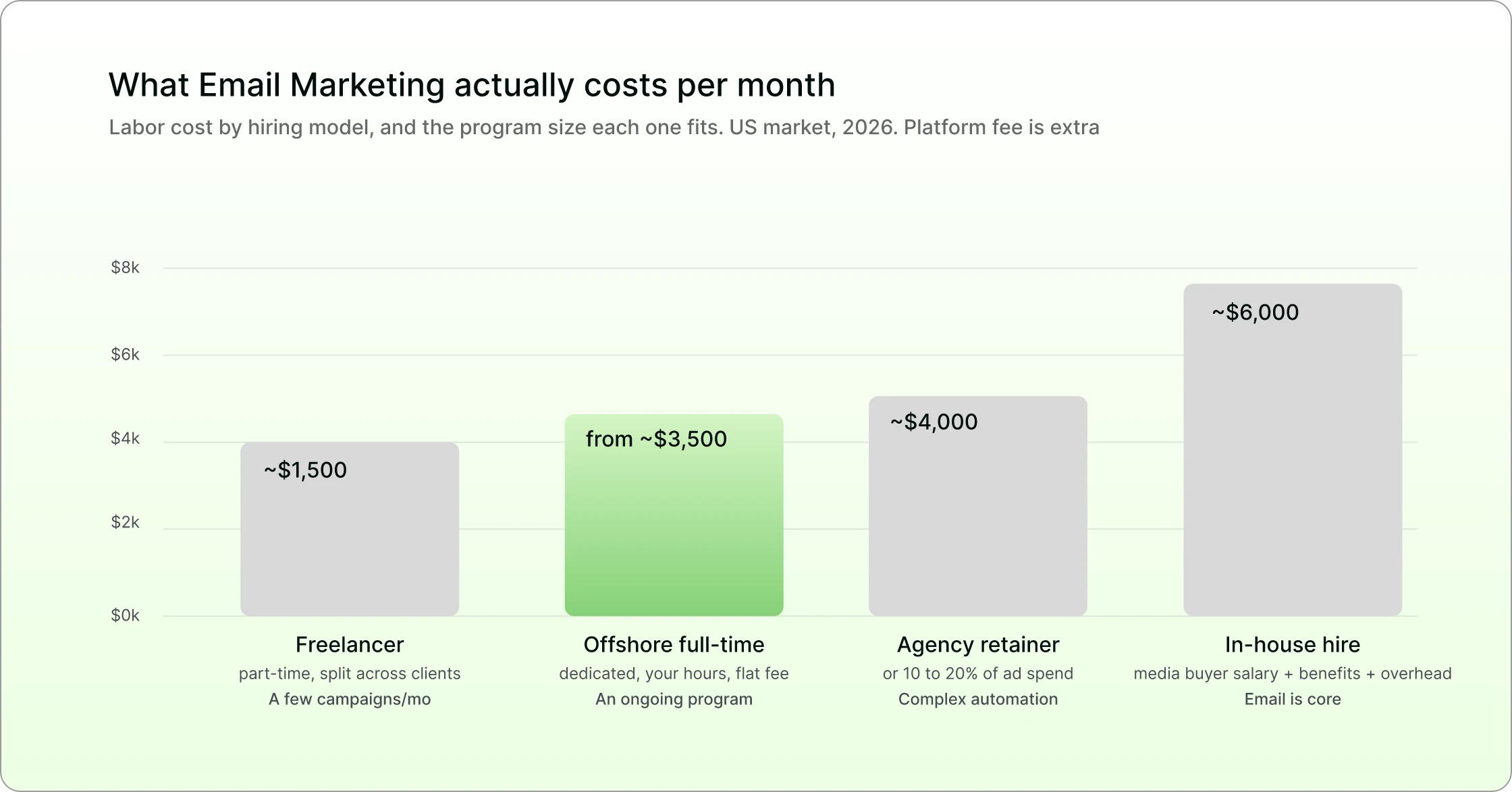
- Freelancer: $500 to $3,000/mo, or $40 to $150/hr.
- Agency: $2,000 to $5,000/mo mid-market, $8,000 to $10,000+ for enterprise or DTC retention.
- In-house specialist: ~$6,000/mo fully loaded (on a $70K to $75K US salary).
- Full-time offshore specialist: from $3,500/mo, flat.
- Platform fee is separate in every model. Klaviyo runs ~$150 to $350/mo at 10K contacts, ~$720 at 50K, scaling with list size.
- Worth it? Email returns roughly $36 to $38 per $1 spent, the highest ROI of any major channel, so the staffing question is about protecting that return, not minimizing line-item cost.
The rest of this guide unpacks each one.
The Four Ways to Staff Email Marketing, and What Each One Costs
Four common models. They price differently because they sell different things: hours, deliverables, an employee, or a dedicated person. One constant across all four: the email platform is a separate line that scales with your list.
The platform fee is the same story in every model: whoever you hire, the Klaviyo or HubSpot bill is yours and scales with your list. It is never bundled into the labor cost.
And the sticker prices are not apples to apples. A freelancer at $75/hr for 15 hours a week is ~$4,500/mo before the time you spend briefing and reviewing. An agency retainer buys a slice of a team, not a person. A salary is just the starting point of what an employee costs.
Freelance Email Marketing Rates
Freelancers are the most flexible and cheapest entry point. You can hire for a specific need, a welcome flow, a weekly newsletter, a one-time list cleanup, and scale up or down month to month.
Rates track experience:
- Hourly: $40 to $85 for most work, $75 to $150 for experienced specialists in major markets.
- Retainer: $500 to $3,000 a month, by volume and complexity.
- Project: $500 to $2,000 for a flow build or template set.
The catch is structural, not personal. A freelancer splits attention across clients, so you buy a few hours of their week, not their focus. If they get sick or take a week off, your sends stop. Deliverability monitoring, list hygiene, and the unglamorous maintenance that keeps a program healthy tend to fall through the cracks when no one owns the account full-time.
- Best for: a contained, well-defined scope you can direct yourself
- Watch out for: divided attention, stalled sends when they are out, skipped maintenance
- Pricing: $40 to $150/hr, or $500 to $3,000/mo on retainer
Email Marketing Agency Pricing
An agency sells you a team and a process: a strategist, a copywriter, a designer, and someone technical for automation and deliverability, all shared across the agency's clients.
Pricing is almost always a monthly retainer:
- Mid-market: $2,000 to $5,000 a month.
- Enterprise / DTC retention (Klaviyo-heavy ecommerce): $2,500 to $8,000, climbing past $10,000 at scale.
The spread reflects send volume, automation depth, and whether SMS is bundled in.
Two things to keep straight: the retainer pays for labor, not the platform (your Klaviyo or HubSpot bill is separate and scales with list size), and you are buying a fraction of a team, great for breadth and technical depth, less great if you want someone who lives in your brand and data every day.
- Best for: genuinely complex automation, strategy bundled with execution, one vendor to manage
- Watch out for: shared attention, long minimums, platform billed separately, renewal increases
- Pricing: $2,000 to $5,000/mo mid-market, $8,000 to $10,000+ for enterprise or DTC retention
In-House Email Marketing Specialist Salary, Fully Loaded
Hiring in-house gets you one person, full-time, focused on your program and your data. The cost question here is the one most teams get wrong: they budget the salary and forget the rest.
The US base salary, across the major 2026 trackers, sits in the low-to-mid $70,000s:
- ZipRecruiter: ~$69,600
- Salary.com: ~$72,200
- Glassdoor: ~$75,300
- Entry level starts ~$50,000 to $55,000; senior specialists clear $87,000+.
Then you load it. A standard HR benchmark puts a full-time employee at 1.25 to 1.4 times base salary once you add payroll taxes, benefits, and overhead, and BLS data shows benefits run about 30% of total comp.
So a $72,000 salary really costs $90,000 to $101,000 a year, roughly $7,500 to $8,400 a month, before the platform.
That is the honest number: not the $72,000 salary, but the $6,000-plus a month (toward the higher end once fully loaded) it takes to keep a US email specialist seated, platform on top. In return you get deep knowledge of your list and flows.
The tradeoff is you also own recruiting, management, retention, and backfilling when they leave and take that list knowledge with them.
- Best for: when email is core, budget is there, and you can retain the hire
- Watch out for: the loaded cost is well above the salary line, plus recruiting and turnover
- Pricing: ~$6,000/mo fully loaded for a mid-level US hire, platform separate
Full-Time Offshore Email Marketing Specialist
Here is the punchline: a skilled, experienced email specialist, full-time (40 hours a week) on your account alone, for roughly half the loaded cost of a US hire.
From about $3,500 a month, flat, you get the focus an in-house employee gives without the US salary, and the dedication a freelancer or agency cannot, because they are split across clients.
The math works because of the local labor market, not a discount on the work.
An email specialist in the Philippines earns a strong local wage at a number well below the US equivalent, because the cost of living is lower.
The fit is natural, too. Email rewards steady daily ownership, sends on schedule, flows maintained, deliverability watched, list kept clean, exactly the kind of execution a dedicated specialist does better than a freelancer splitting attention. You bring the strategy and direction. They run the program day to day.
The one catch is that quality depends entirely on vetting, which is where a specialized partner beats a generic job board.
That is the part worth understanding next.
- Best for: full-time, dedicated execution far below a loaded US salary
- Watch out for: quality depends on vetting, so the partner matters; you provide direction
- Pricing: from $3,500/mo, flat, for a dedicated full-time specialist, platform separate
Why GrowthAssistant is built for this exact role
GrowthAssistant exists because of one pairing. Co-founder Jesse Pujji built Ampush, one of the world's leading performance marketing agencies (sold to Tinuiti in 2021), where he ran a large offshore team and learned firsthand what great marketing talent looks like.
Co-founder Adriane Schwager spent years leading recruiting for a major hedge fund, screening tens of thousands of applicants. Lifelong friends, they paired his eye for marketing talent with her hiring engine.
Email is a high-trust role, the specialist owns your list, your flows, and your deliverability, so that mix of marketing know-how and rigorous vetting is exactly what it takes to place someone you can hand the program to.
That is why the quality bar is the whole product:
- Roughly 1 in 400 applicants makes it through.
- Every specialist is AI-certified before day one, with ongoing training.
- Each works full-time on your hours, backed by a dedicated success manager.
- The 100% Match Guarantee covers a free replacement, any time, if the fit is not right.
This is not theoretical for email. GrowthAssistant runs the email, CRM, and lifecycle work for brands like DoorDash, SoFi, Codecademy, and Mack Weldon.
Across these roles the median rate is about $3,900 a month for a full-time, dedicated specialist, platform separate.
It lands a little above the $3,500 floor because email roles skew toward Klaviyo, HubSpot, and lifecycle specialists rather than general assistants.
Email Marketing Specialist Job Description (Free Template)
If you decide to hire, here is a job description you can lift and adjust. It reflects what the role actually does day to day, drawn from how it is staffed across real programs.
Role summary
The Email Marketing Specialist owns the planning, building, and optimization of email campaigns and automated flows. They turn strategy and brand direction into sent, tested, and reported-on email that drives retention and revenue. This role executes; it does not set the overall marketing strategy.
Responsibilities
- Build, schedule, and send campaigns and newsletters in the email platform (Klaviyo, HubSpot, Mailchimp, or similar)
- Set up and maintain automated flows: welcome, abandoned cart, post-purchase, win-back, re-engagement
- Write and edit email copy, or adapt it from the content team, and coordinate design assets
- Run A/B tests on subject lines, send times, and content, and report what wins
- Manage list segmentation, hygiene, and suppression to protect deliverability
- Monitor deliverability, open, click, and conversion rates, and flag issues early
- Maintain a campaign calendar and hit send deadlines reliably
- Pull and share performance reporting against goals
Required skills
- Hands-on experience in at least one major email platform
- Strong grasp of segmentation, automation logic, and deliverability fundamentals
- Comfort with basic HTML for email is a plus
- Clear written communication and sharp attention to detail
- Ability to work from SOPs and brand guidelines without heavy oversight
Nice to have
- SMS marketing experience
- Familiarity with ecommerce platforms (Shopify and similar)
- Light design ability in Figma or Canva
Use this as a starting point and tailor the platform and channel mix to your stack.
So What Should You Actually Budget?
Match the model to the situation, and add the platform fee on top in every case.
- A few campaigns a month, you can direct it: a freelancer at $500 to $2,000 a month.
- Complex automation, want strategy plus execution, one vendor: an agency at $2,000 to $5,000 a month mid-market.
- Email is core and you want a US employee you fully control: ~$6,000 a month all-in, plus platform.
- The hybrid most teams land on: an in-house lead or founder owning the strategy, segmentation logic, and brand voice, with a GrowthAssistant specialist building, sending, testing, and maintaining the program day to day on a flat fee. You keep the strategy and hand off the execution, usually for less than a loaded US salary (platform separate in either case).
- An ongoing program run daily, without a US salary: full-time offshore from $3,500 a month, plus platform.
Whatever model you choose, keep the platform fee as its own line. Labor cost and software cost are different budgets, and email is the channel where blending them hides what the program really costs.
If you're still weighing whether to keep this in-house at all, this guide on how to outsource email marketing without sacrificing quality walks through that decision first.
Quick guide: which model fits
- Tightest budget, simplest needs: freelancer. Divided attention, you own the direction.
- Most technical complexity, least desire to manage people: agency. A premium for a full team and hands-off reliability.
- Email is mission-critical, budget is there: in-house. You own the cost and the management, and the knowledge stays with you.
- Best balance of dedicated focus and cost: full-time offshore. One person's full attention without a loaded US salary; you still set strategy.
Where GrowthAssistant Fits
If the offshore route fits, here is what an offshore email marketing specialist from GrowthAssistant does day to day: builds and schedules campaigns and newsletters, sets up and maintains flows (welcome, abandoned cart, post-purchase, win-back), runs A/B tests, manages segmentation and list hygiene, watches deliverability, and reports on what is working. They live in your account so you do not have to.
For email specifically, tenure matters more than most channels: a specialist who stays learns your list, your flows, and your deliverability quirks instead of taking that knowledge out the door every year. Across GrowthAssistant placements, average tenure runs about 18 months.
Your specialist works full-time, 40 hours a week on your hours, for one client: you.
You can swap roles within your subscription as your needs change, and the 100% Match Guarantee covers a free replacement at any time if the fit is not right. You bring the strategy and direction. Your Growth Assistant brings the execution.
Starting at $3,500/month for an email specialist. Month to month. No placement fee.


.svg)

