



An AI marketing use case is a specific marketing task with reliable inputs, a clear deliverable, and someone responsible for checking the output.
For a marketing leader, the practical question is where AI can remove a bottleneck without creating more review work. A content team waiting on briefs needs a different workflow from a paid media team waiting on creative or a sales team receiving incomplete lead handoffs.
This guide breaks down 16 practical examples by team and channel. Each includes what to give the AI, what it should produce, who owns the decision, and how to measure the result. Most workflows are illustrative. The influencer marketing section links to a GrowthAssistant walkthrough, and the final example describes a practitioner's editorial process.
What counts as an AI marketing use case?
An AI marketing use case applies a model to a defined marketing task: generating a draft, interpreting unstructured information, predicting an outcome, or identifying patterns. It is more specific than “use AI for growth” and does not necessarily require an autonomous system.
- Generative AI: drafts campaign copy, summarizes interviews, or proposes creative concepts from a brief.
- Predictive AI: estimates lead conversion likelihood or an appropriate send time using historical signals.
- Classification and pattern analysis: groups customer feedback, labels content, or identifies unusual performance changes.
Sending a reminder three days after a form submission is rules-based automation. Asking AI to summarize the person’s stated needs and route that summary to a review queue turns it into an AI marketing automation workflow, giving your team useful context to review before following up.
AI marketing use cases at a glance
Use this shortlist to match a workflow to the bottleneck your team actually has. AI can help with tasks across content, acquisition, lead nurturing, and reporting, but the best starting point depends on where work gets delayed and what information your team can reliably provide.
| Use case | Examples | Best-fit team | Required inputs | Primary metric |
|---|---|---|---|---|
| Content and SEO | 1, 2, 3, 16 | Content / SEO | Transcripts, keywords, URL inventory | Approved output and organic conversions |
| Paid media | 4 | Acquisition | Approved claims, creative brief | Cost per qualified acquisition |
| Email and nurturing | 5, 6 | Lifecycle | Segments, offers, engagement history | Qualified replies or conversions |
| Creator partnerships | 7 | Influencer marketing | Creator profiles, campaign brief | Qualified partnerships |
| Lead scoring | 8 | Marketing / sales operations | Historical lead outcomes | Sales acceptance and missed qualified leads |
| Reporting and CRM | 9, 10 | Marketing operations | Validated metrics, authorized records | Accuracy and preparation time |
| Landing-page experiments | 11 | Growth / CRO | Objections, page copy, funnel data | Qualified conversions per visitor |
| Customer feedback analysis | 12 | Product marketing | Interviews, surveys, reviews | Theme accuracy and messaging test results |
| Retention | 13 | Lifecycle / customer success | Renewal history, engagement signals | Incremental renewals |
| Recommendations | 14 | Ecommerce / content | Catalog, permitted behavioral data | Revenue or qualified engagement |
| Conversational qualification | 15 | Demand generation | Knowledge base, routing criteria | Qualified meetings |
Start with one recurring task that has clear inputs, a defined output, and someone responsible for checking the result. For example, if your team spends hours turning interviews into article outlines, an AI-assisted brief may be a useful first test. The examples below show how to translate these opportunities into practical workflows.
16 practical AI marketing examples by team and channel
1. Turn expert interviews into content briefs
Example: A B2B content team has a recorded interview with a subject-matter expert but no clear article outline.
Workflow: Provide an approved transcript, audience description, and content goal. Ask AI to extract the expert’s main arguments, unanswered questions, and supporting passages, then suggest an outline. The deliverable is a brief with source references, not a publish-ready article.
Human owner: A content marketer checks every quotation, resolves gaps with the expert, and adds firsthand examples. Do not let the model invent customer stories or statistics.
Measure: Brief preparation time, revision rounds, and the share of briefs accepted by the editor.
2. Repurpose one approved asset for several channels
Example: A webinar needs follow-up emails, LinkedIn posts, and short video clips.
Workflow: Give AI the transcript and campaign brief. Ask for three distinct post angles, a recap email, and candidate clips with transcript timestamps. Keep each derivative tied to a specific passage so the editor can verify it.
Human owner: A content or social specialist checks the original recording, adapts the message to each channel, and approves the final assets. A transcript timestamp is a proposed edit point, not proof that the clip works visually.
Measure: Time per approved asset and qualified visits or conversions from each distribution channel. More drafts alone are not a business result.
3. Find content refresh and internal-link opportunities
Example: An SEO team has a large article library and needs to choose which pages deserve an update.
Workflow: Supply page text, a URL inventory, and Search Console exports for comparable periods. AI can group related queries, suggest gaps, and identify relevant source-and-destination pairs for internal links. Ask it to use only URLs in the inventory.
Human owner: An SEO specialist checks search intent, page overlap, seasonality, and whether a suggested destination is live and indexable. Traffic declines do not automatically justify deleting or consolidating a page.
Measure: Implementation time, relevant non-branded clicks, and qualified organic conversions. Compare page groups and account for other changes before attributing gains to the workflow.
Google Search Central’s guidance on generative AI content emphasizes accuracy, quality, and relevance. Use AI to support research and structure while adding original expertise; producing many pages without added value can violate Google’s spam policies.
From GrowthAssistant's experience: In our AI SEO agent case study, automated publishing put articles live before anyone reviewed them. The team brought a Growth Assistant back into the process to apply editorial and SEO judgment. For content refreshes, the lesson is to review recommendations against search intent and business priorities before applying them.
4. Build ad variations around a clear hypothesis
Example: A paid social team wants to test whether a time-saving message performs better than a cost-saving message.
Workflow: Provide approved product facts, audience pain points, brand examples, and the two angles. Ask AI for a small set of hooks and visual concepts for each angle, labeled by hypothesis. This makes the output easier to test than a pile of unrelated ads.
Human owner: A media buyer and designer check claims, product appearance, brand fit, and platform requirements. Set the budget and test conditions before launch; an AI-generated ad is not automatically an approved ad.
Measure: Cost per qualified lead or acquisition, plus production time and rejection rate. Use click-through rate as a diagnostic rather than the sole winner criterion.
Using AI for creative testing can help teams turn approved briefs into ad variations for review and testing. Each asset still needs a human check before publication: Google’s guidance on generated ad assets makes clear that generation does not guarantee policy approval.
In practice: GrowthAssistant's AI Designer and UGC Video Editor role accelerators connect creative production with role-specific AI training. The workflow above still needs a media buyer to define the test and a designer to approve the assets.
5. Draft nurture emails for different buying stages
Example: A SaaS team needs different follow-up messages for educational-content subscribers and demo-ready prospects.
Workflow: Use approved audience segmentation rules, customer questions, and offer details to draft a short sequence for each group. AI can adapt the explanation and CTA while leaving eligibility and suppression rules in the marketing platform.
Human owner: An email marketer validates links, merge fields, audience membership, exclusions, and the offer. Test the message in context, including what the recipient has already received.
Measure: Qualified replies, booked meetings, or revenue per recipient, depending on the sequence. Monitor unsubscribes and complaints alongside the main metric.
From GrowthAssistant's experience: In the Ode à la Rose case study, a dedicated Growth Assistant worked in Klaviyo, simplified newsletter variations, and focused sends on engaged subscribers. The case reports a 29% increase in newsletter and campaign revenue in Q1 2026 versus Q1 2025 without more sends. This is evidence of dedicated email ownership, not a measured result from AI-generated nurture copy.
6. Test predictive send times and channel selection
Example: A lifecycle team sends recurring campaigns to an established audience and has reliable engagement history.
Workflow: If the email platform offers predictive send-time optimization, use it to estimate when recipients may engage. Compare it with the existing schedule using a randomized control group when supported. Where the platform supports predictive channel selection, also test which authorized channel fits each recipient's engagement history. Respect channel preferences and frequency limits. A fixed timezone rule is useful automation but is not predictive AI.
Human owner: An email marketer confirms feature eligibility, scheduling constraints, and sufficient data. Keep the message and audience comparable. New lists or infrequent sends may not provide enough signal.
Measure: Clicks and downstream conversions per delivered email. Open rate alone can be misleading, so pair it with behavior closer to the business goal.
Use behavioral audience segments to compare results across relevant groups while keeping consent, exclusions, and contact frequency consistent.
7. Prepare creator research and outreach drafts
Example: An influencer team has an approved creator shortlist but spends too long reviewing profiles and writing first messages.
Workflow: Provide relevant public profile information, approved campaign details, and examples of suitable partnerships. Ask AI to summarize fit and draft an opener grounded in a specific piece of content.
Human owner: An influencer marketer checks the cited post, audience fit, and partnership requirements, then approves outreach through the team’s authorized process. Do not invent familiarity with a creator or infer sensitive personal traits.
Measure: Research time per approved creator, positive reply rate, and qualified partnerships. Message volume by itself does not show partnership quality.
In practice: GrowthAssistant’s AI influencer messaging workflow
GrowthAssistant built an influencer messaging workflow that connects creator research, Google Sheets, and a fine-tuned AI model. When a creator is added to the sheet, the workflow triggers message generation using creator context and instructions for tone and structure.
In the published walkthrough, the team uses Unload, a digestive supplement brand, to demonstrate how the system identifies relevant creators and generates tailored outreach.
The example shows how research and drafting can become a repeatable process. For teams adopting this approach, the human review step is to verify creator fit, check the personalization, and approve messages before sending.
Read the full GrowthAssistant influencer messaging walkthrough for the implementation details.
8. Prioritize leads with predictive scoring
Example: Marketing and sales have a consistent qualification definition and enough historical outcomes to evaluate a predictive model.
Workflow: Use a suitable scoring system to estimate conversion likelihood from permitted firmographic and behavioral signals. Compare its ranked leads with the existing process before allowing scores to influence routing.
Human owner: Marketing operations and sales define the outcome, check data quality, and review missed opportunities. Exclude information recorded only after conversion from training inputs. Keep routing rules and manual overrides explicit.
Measure: Sales acceptance, conversion among prioritized leads, and missed qualified leads. Evaluate on later, unseen records and review performance across relevant segments.
9. Turn CRM notes into useful handoff summaries
Example: Sales receives leads with scattered form responses and meeting notes, making handoff preparation inconsistent.
Workflow: Give AI the relevant authorized records and a fixed summary format: stated need, current setup, timeline, unanswered questions, and source references. Save the output as a draft note for review.
Human owner: An operations specialist checks identities and source records before saving updates. Leave unknown fields blank. Do not automatically overwrite CRM fields, merge contacts, or change deal stages based on a generated summary.
Measure: Preparation time, factual correction rate, and the share of handoffs sales accepts without requesting missing context.
10. Draft weekly performance commentary and investigate anomalies
Example: A marketing lead has a validated dashboard but spends hours writing the same reporting narrative.
Workflow: Provide reconciled campaign data, metric definitions, comparison periods, and a change log. Use a statistical or analytics system to flag unusual movements; ask a language model to summarize those flags and propose checks. Require it to separate observations from hypotheses.
Human owner: A marketing analyst verifies calculations in the reporting system and investigates tracking, spend, audience, and landing-page changes. AI should not present an inferred cause as an established explanation.
Measure: Report preparation time, numerical error rate, and time to investigate meaningful issues. Track false alarms so monitoring does not become more work than it saves.
Connecting the validated report to a recurring trigger and a review queue creates an AI marketing automation workflow. Keep the analyst's approval before commentary is shared or campaign changes are made.
11. Turn customer objections into landing-page experiments
Example: A B2B landing page attracts relevant visitors, but feedback suggests they do not understand the service or next step.
Workflow: Supply anonymized sales objections, page copy, and funnel data. Ask AI to group the objections and propose one test per theme, with a hypothesis, proposed change, and success metric. Start with reviewed copy variants before attempting dynamic personalization.
Human owner: A growth marketer checks whether the evidence supports each hypothesis and sets the experiment design. Use approved facts for every variant and keep a fallback experience. If traffic is too low for a useful A/B test, prioritize research and usability fixes.
Measure: Qualified form submissions or booked meetings per eligible visitor, plus lead quality. Run tests long enough for the planned sample and sales follow-up; a few early conversions are not a reliable winner.
12. Analyze reviews and customer feedback for messaging
Example: A product marketer needs to understand recurring purchase triggers, objections, and reasons customers stay.
Workflow: Provide a permitted, anonymized set of interviews, surveys, or reviews. Ask AI to label themes, attach supporting excerpts, and distinguish common patterns from isolated comments. Use the output to develop messaging hypotheses and sales enablement briefs.
Human owner: A product marketer reviews a sample from every theme, checks contradictory feedback, and notes who is missing from the sample. Theme frequency in a selected dataset is not a measure of the entire market.
Measure: Analysis time, agreement between human and AI labels, and whether the resulting hypotheses improve tested messaging.
13. Identify at-risk customers for retention campaigns
Example: A subscription business wants to prioritize outreach before customers fail to renew.
Workflow: Use a validated predictive model with historical renewal outcomes and permitted engagement signals to identify accounts for review. Prepare a relevant retention message based on the customer's actual situation. A rule such as “no login in 30 days” is a useful trigger, but is not itself an AI prediction.
Human owner: A lifecycle marketer and customer success lead check the signals, exclusions, and proposed offer before outreach. Keep a comparable holdout group to evaluate whether the intervention changes outcomes.
Measure: Incremental renewal rate, retained revenue, and offer cost. A high risk score alone does not show that a discount or message will prevent churn.
14. Recommend relevant products or content
Example: An ecommerce team wants to help shoppers find complementary products; a B2B team wants to suggest a useful next resource.
Workflow: Use an appropriate recommendation system with a current product or content inventory and permitted behavioral data. Define eligible recommendations and a fallback for visitors with little history. Test recommendations against the existing experience.
Human owner: An ecommerce or content marketer checks availability, relevance, exclusions, and the destination pages. Product recommendations should respect inventory and margin constraints.
Measure: Incremental conversion rate, revenue per visitor, or qualified content engagement, depending on the objective. Monitor returns and irrelevant recommendations alongside the primary metric.
15. Qualify inbound prospects with conversational AI
Example: A marketing team receives recurring website questions but cannot respond to every inquiry immediately.
Workflow: Give an AI assistant an approved knowledge base and a short qualification framework. Let it answer supported questions, collect relevant needs, and route the conversation to the appropriate person. Connect the handoff to the CRM only through authorized integrations.
Human owner: A demand generation or operations specialist reviews conversation samples, maintains the knowledge base, and defines when the assistant must escalate. Pricing exceptions and unsupported claims go to a person.
Measure: Qualified meetings per conversation, answer accuracy, and successful human handoffs. Track unanswered questions and abandoned conversations.
16. Connect keyword research to an editorial calendar and CMS drafts
Example: Our SEO practitioner uses a workflow that connects an Ahrefs keyword spreadsheet, Claude, ClickUp, and Webflow. This practitioner example is based on her description of the process.
Workflow: Build the keyword spreadsheet using the Ahrefs MCP connection, then use Claude to turn that research into an editorial calendar. Create the corresponding ClickUp task and prepare the article directly as a Webflow CMS draft. Review the draft and schedule it only after approval. These are connected work stages; the process does not require every step to run unattended.
Human owner: The SEO editor owns topic selection, search intent, factual accuracy, brand fit, internal links, and final approval. Keep publication separate from draft creation. For teams adopting this process, record the approved version and publication date in the task.
Measure: Track research-to-draft time, review rounds, factual corrections, and the share of approved articles delivered on schedule. No measured time savings or traffic gains are claimed for this example.
From keyword research to an approved publication
Text version: Ahrefs keyword research feeds monthly planning in Claude, followed by the editorial calendar and cluster map, ClickUp tasks, weekly production, a Webflow draft, a design task, and the attached image. Our SEO practitioner reviews the complete draft. Requested changes return to production and review; approved content moves to scheduling.
Swipe or scroll sideways to explore the workflow. Enlarge diagram.
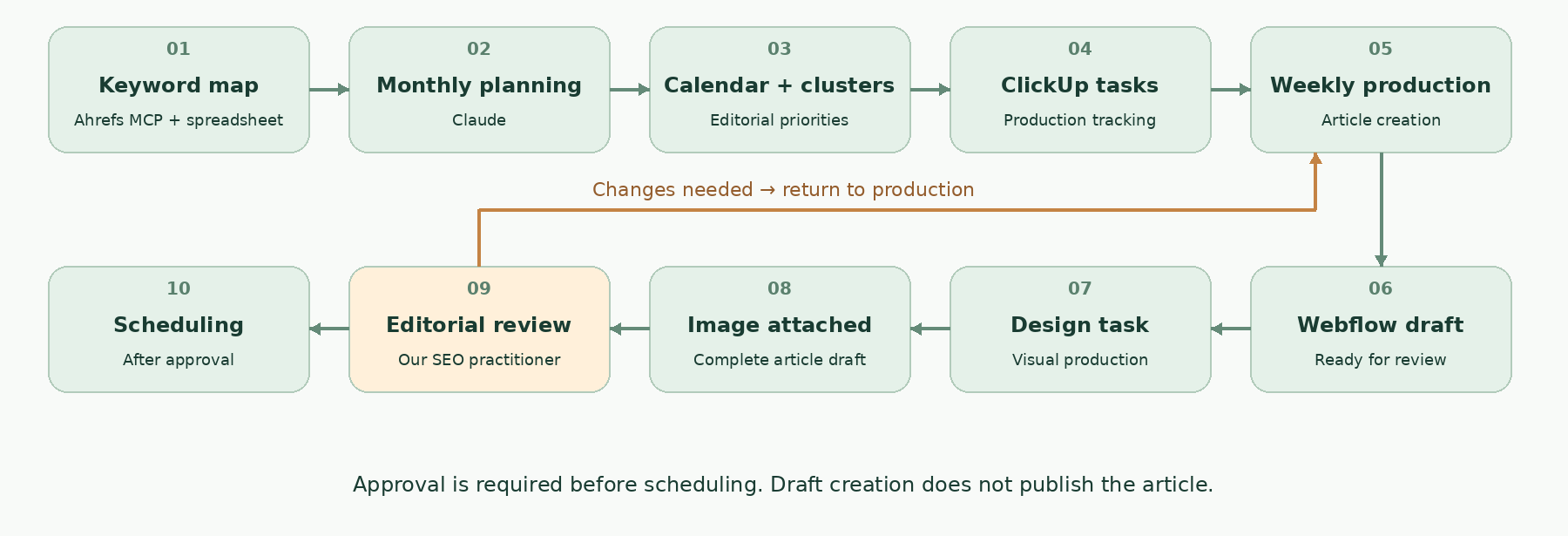
Why the approval step matters: Our experience with an AI SEO agent showed the risk of letting generated content go live without QA. In this editorial workflow, creating the Webflow draft and approving publication are separate steps.
Three prompts to start with
Use these templates in an approved AI tool and replace the brackets with your own inputs. Provide only information your organization permits that tool to process. The instruction to cite a source helps review; it does not replace verification.
For recurring tasks, marketing Skills for Claude can package instructions and reference materials so the team can reuse its process instead of rebuilding every prompt.
Content repurposing prompt
Using only [approved transcript], draft three LinkedIn posts for [audience]: one practical tip, one objection response, and one discussion question. Follow [brand voice examples]. Include the supporting transcript passage for each post. Do not invent quotes, statistics, or customer results. Mark missing information as “needs review.”
Paid media concept prompt
Using [approved offer facts] and [audience research], propose three ad concepts testing [hypothesis]. For each, provide the hook, visual idea, supporting product fact, and CTA. Follow [brand constraints]. Flag unsupported claims. Keep the offer consistent so the test compares the intended message.
Performance reporting prompt
Summarize [validated performance table] using [metric definitions] and [comparison periods]. Separate observed changes, possible explanations, and checks needed. Reference the relevant rows. Do not infer causation or fill missing values. Use the supplied verified calculations and flag any apparent inconsistencies for the analyst.
How to choose the right AI use case for your team
Start with a recurring task whose inputs and quality standards are already clear. If nobody can explain what good output looks like, automating the task will make the ambiguity harder to manage.
- Find the actual bottleneck. List work delayed by research, drafting, analysis, or handoffs. Estimate how often it happens and how much time it takes.
- Check the evidence available. A source-grounded draft can begin with one good transcript. Predictive scoring needs historical outcomes and enough relevant examples to evaluate reliability.
- Define the review step. Name the person who accepts the output and the conditions that trigger escalation.
- Consider the cost of mistakes. An internal draft is easier to correct than an incorrect customer message or an automated budget change.
- Pick a measurable pilot. Write down the baseline, the target deliverable, and the conditions for continuing or stopping before you start.
For a small B2B team, interview-to-brief or webinar repurposing can be a sensible first test because the source material and review step are easy to define. For an ecommerce team with an active creative program, ad concept development may address a more valuable constraint. These are starting hypotheses; choose based on your own workload.
Once the task is clear, compare AI marketing tools based on the inputs, integrations, and review steps your workflow requires. Check whether your existing platforms can handle the task before adding another subscription.
How to measure AI marketing results without overstating ROI
Track efficiency, quality, and business outcomes separately. A workflow can save drafting time while increasing editing time, or produce more assets without generating more qualified demand.
- Efficiency: total time per approved deliverable, including preparation, prompting, review, corrections, and maintenance.
- Quality: factual errors, rejected outputs, revision rounds, and compliance with the brief.
- Business impact: qualified leads, booked meetings, customer acquisition cost, or revenue, matched to the workflow and measured over an appropriate period.
Net time saved = baseline time − total time with AI. For example, if a weekly task previously took six hours and now takes two hours to prepare and generate plus two hours to review and maintain, the saving is two hours. This is an illustrative calculation, not a performance benchmark.
To estimate financial value, multiply verified hours saved by the relevant hourly cost, then subtract incremental tool and implementation costs allocated to that period. Treat released capacity separately from actual cash savings. Add incremental profit only when you have a defensible way to attribute it; do not count the same benefit twice.
For campaign tests, agree on the primary metric, control group, sample requirements, and stopping rules in advance. For longer B2B sales cycles, review lead quality and later pipeline outcomes before calling a short-term conversion lift a success.
A practical 30-day pilot plan
Thirty days can help establish whether a workflow is usable. It may not be enough to prove revenue impact or reach an experiment’s required sample size.
- Week 1: Document the baseline. Choose one recurring task, collect representative inputs, record current time and quality, and assign the reviewer.
- Week 2: Run alongside the existing process. Produce drafts or recommendations without allowing automatic external actions. Record errors and missing context.
- Week 3: Improve the handoff. Refine prompts, source material, and review criteria. Test awkward inputs, not just the cleanest example.
- Week 4: Decide whether to continue. Compare total effort and output quality with the baseline. Expand only if the workflow is useful and the owner can maintain it.
Keep a short operating document covering the trigger, approved inputs, expected output, reviewer, exceptions, and how to pause the workflow. Set a review cadence for changes in offers, source data, and tools.
Who should own AI marketing workflows?
The person responsible for the channel should remain accountable for the result. A specialist can prepare inputs, operate the workflow, check drafts, and maintain documentation; marketing leadership sets priorities and approves strategic changes.
For example, an email marketer can manage nurture drafts and campaign QA, while a marketing data analyst validates the reporting workflow. Predictive scoring and CRM changes may also require sales operations or technical support.
Put AI marketing workflows into practice with the right talent
GrowthAssistant connects marketing teams with full-time, AI-certified talent who can manage recurring workflows, review outputs, and keep execution moving. Each placement completes GrowthAssistant's internal AI certification before joining a client team.
GrowthAssistant serves more than 200 clients and backs its placements with a match guarantee, including replacements at no extra cost. Plans start at $3,500 per month; the quote for your role depends on its scope and requirements.
Tell us which marketing workflow you need someone to own, the tools your team uses, and the outcomes you want to improve. We'll help you scope the role and find a match.