



Your next customer heard of you from Claude.
They searched your SKU. Your product. And because of the GEO playbook you ran, your product was recommended with high trust and less consideration.
Search is changing quickly.
Traditional SEO still matters. Most teams are built for this, but they’re not built to show up on LLM search, which takes a similar skillset but a different strategy and team to win on.
👀 Customers who came from LLM search are 3x more likely to convert. Is your marketing team converting them?
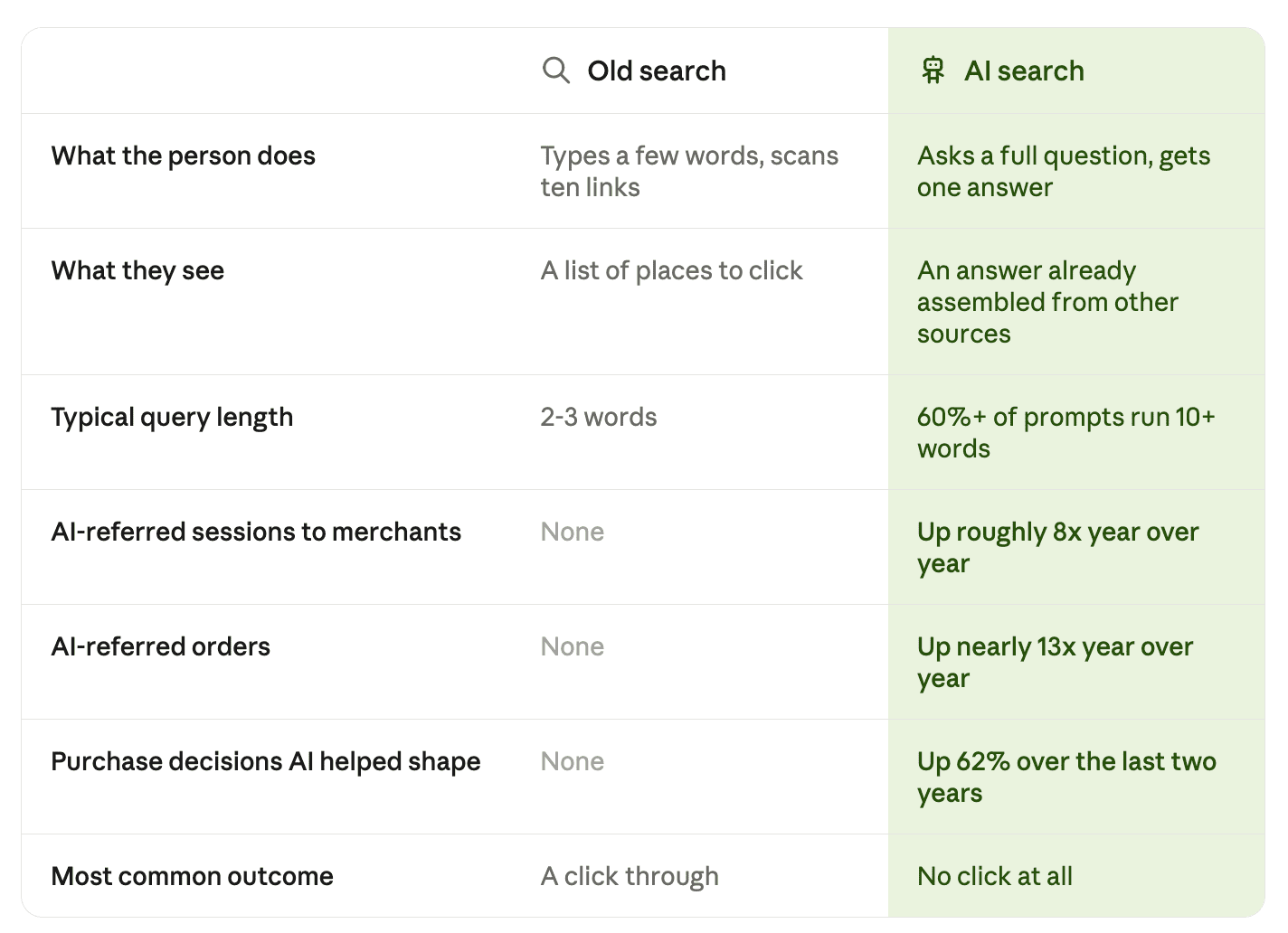
Claude and ChatGPT have the fastest adoption periods of recent technology tools, and are drastically changing how customers are discovering products. Google’s AI Overview and AI summaries are concentrating the research phase to single sentences. What appears on search has never been more important.

Reverse Engineering LLM Search So You’re Named in the Prompt
In 2025, search was about talking about GEO (and what AEO was).
In 2026, search is about building a strategic GEO, SEO, and AEO team that works backwards to appear on the most important keywords and prompts consistently.
That will take three things:
- Technical chops for both SEO and GEO
- Marketing strategy to play on the right channels (and avoid the noise)
- Keywords that drive traffic to your site
We’ve placed talent experts in this workflow. We’ve seen how the highest-performing teams at brands like Harry’s, DoorDash, and Calm are folding GEO into their successful search programs at scale, and we’re sharing the signals, tools, and workflows that make it work.
Who Is GrowthAssistant?
We place the world’s best AI-trained marketing talent, built into your team.
We match you with rigorously vetted, AI-fluent marketers and designers who work your hours, think like your team, and cost up to 60% less than a US hire.
We’re built by Jesse Pujji, a founder who scaled with global talent. He scaled Ampush, a performance marketing agency, to 8 figures leaning on the same global talent we place today.
After building and stress-testing a global hiring system across 200+ clients, he packaged that same system into GrowthAssistant.
Ready to find your marketing match? GrowthAssistant places video editors, paid social marketers, and designers trained in this exact workflow.
1/ Where Do I Stand Today? (And Who to Trust…)
The background every CMO needs before spending a dollar, inspired by the questions we hear most from high-growth leaders who want to see an ROI on GEO before investing in it.
AEO vs. GEO vs. SEO (What’s the Difference?)
They’re all doing the same job: getting people to look at your website.
The difference is in the methods. Don’t waste time on what they’re supposed to be. Understand the differences and start winning with the one that makes the most sense for your team.
The Old Way to Get Discovered: Single Funnel
For two decades, the job had one name. SEO meant building pages Google trusted enough to rank, and trust came from a stable, well-understood set of signals: relevant content, technical health, and a web of other sites vouching for you.
There was one crawler that mattered, one results page that counted, and one scoreboard, your rank, that told you whether it was working.
You optimized a page, you waited, you checked the rank. The loop was slow, but it was legible.
That legibility is gone, and it didn’t disappear because SEO stopped working. It disappeared because the thing reading your content multiplied.
The New Recipe: Same Clues, More Detectives
AEO, answer engine optimization, showed up when featured snippets and voice assistants started pulling a single answer out of a page instead of sending someone to it.
GEO, generative engine optimization, is the newest and broadest label, covering the fact that ChatGPT, Gemini, Perplexity, and Google’s AI Overviews now write an entire synthesized response instead of surfacing one snippet or one link.
Three names. One underlying question: is your brand the thing worth citing?
That’s not a rhetorical flourish, it’s the actual mechanism. Ask a generative engine a question and it isn’t inventing an opinion. It’s reading across the open web live, weighting sources by trust and relevance, and assembling an answer out of the pieces it trusts most.
The engines are new. The raw material they’re pulling from is the same content ecosystem that’s always been available in the search journey.
What’s Actually Different Here?
Here’s the part that’s genuinely new. Generative platforms lean heavily on top-ranking search results and already-trusted sources to build their answers, which means a brand that doesn’t rank well organically usually doesn’t get cited either.
Strong SEO is still the floor. But it’s not the ceiling anymore.
Here’s what it means in practice: SEO earns you a position on a results page, a slot a human has to click to unlock the value.
AEO and GEO earn you a mention or a citation inside an already-synthesized answer, which means your content has to be extractable in pieces, not just well-ranked as a whole page.
A blog post that ranks first but buries its actual answer three scrolls down can win the click under old SEO rules and still lose the citation under GEO rules, because the model never gets far enough down the page to find the part worth quoting.
Same page. Same ranking. Different outcome, because the reader changed.
What to Trust Before You Spend a Dollar
Most GEO advice is speed dressed up as strategy.
Listening to the noise is the fastest way to burn a quarter’s budget. This section breaks down the signal behind the GEO strategy that scales vs. what creates quick wins with big consequences.
SEO: Slow Earned Optimization
SEO built its credibility the hard way.
Tactics took months to test, results took months to show up, and a genuinely bad idea, like keyword stuffing or link farms, usually got caught by Google’s own algorithm updates before it could do too much damage anywhere else.
The result: a slow feedback loop that filtered out bad advice, because it simply stopped working.
GEO doesn’t have that history yet.
It’s maybe two years old as a real discipline, which means the industry advising on it is mostly building the plane while flying it, and a lot of the people doing the loudest advising haven’t been doing this long enough to have watched a bad idea actually fail.
The danger of GEO is that the feedback loop is shortened. AI bots crawl the web live, every minute, meaning the strategy your team executes on has high visibility, quickly.
The Tell-Tale Sign of a GEO Snake Oil Salesman
Someone promising guaranteed visibility across every AI engine at once, or a fixed number of citations within thirty days, is selling certainty in a space that doesn’t have any yet.
The honest state of the research is unglamorous:
- No one has proven ROI from installing an llms.txt file.
- No one has proven ROI from adding schema markup.
- No one has proven ROI from adding Reddit reviews to power LLM search over a consistent amount of time, across all industries.
There are dozens of things that correlate with visibility, but almost nothing has been isolated as a guaranteed cause.
Where’s the Risk of GEO?
The riskiest tactics don’t look risky, until they are. GEO can have big consequences:
One DTC brand ran a bulk-content play, trusting a GEO agency that promised quick wins within a month. Dozens of AI-written listicles, published all within a week, targeting every long-tail variation of their category.
Within weeks, rankings climbed. For those three weeks, it was working. AI answer engines lean heavily on the same underlying search indexes. A site that gets penalized in Google quietly stops showing up in AI citations too, on a lag long enough that most teams never connect the two events. They just watch both numbers fall and assume the algorithm changed.
Stop This Now: Self-Referencing
SEO growth hacks don’t always carry over to GEO. In fact, they often have big consequences.
For example, the self-referencing article post: publishing your own “best agencies in this category” list and ranking yourself first.
It works for a while, since the model will cite your own listicle the same way it cites anyone else’s, and it worked for SEO while your customers are price-shopping.
The problem shows up downstream, quietly. Some AI systems have started recommending the competitors named inside those self-published lists instead of the brand that wrote them, treating your own comparison as evidence for someone else’s case.
A list that’s obviously grading its own homework is a harder source to trust, for a model built to weigh credibility and for a buyer doing the same thing manually. That erosion happens slowly enough that most teams don’t notice until the tactic’s already backfired on them.
GEO Growth Hacks Have a Short Lifespan
The average GEO quick win only lasts for a month.
Case Study: LinkedIn Pulse Posts
LinkedIn Pulse articles were a high-performing GEO format in Q1. These were short articles anyone could publish on LinkedIn, quick 5–10 minute reads. They were a fast, reliable way to rank high on Google and got swept into AI citations in the process. These weren’t an organic social play — they were purely SEO focused.
At the end of Q3, something changed. Google’s ranking algorithm stopped surfacing Pulse posts, aside from accounts with an exceptional following, and overnight the rankings for Pulse posts fell off a cliff.
The lesson: Teams that spent time batching LinkedIn articles gained traction for 3 months. Today, that strategy is obsolete. When planning how to scale on GEO, consider whether the tactic is long-term or a quick win.
Before You Fund Anything… Ask This Question
Is this durable or fast?
There’s a time for either: choose the fast win if there’s a seasonal event you’re trying to win, or in a period where you know search will spike and it’s important to show up more.
Choose the durable wins if you’re establishing a longer-term program, hiring for the program, and need the repeatable workflows that new hires can run, and are betting heavily on GEO.
Fast and durable occasionally overlap, and when they do, you’ve found a genuinely good tactic. When they don’t, durable is the one still working in six months, and fast might be the one you’ll be explaining to your CFO in a board deck titled “What Happened to Our Rankings.”
Cheatsheet: Tools to Trust
We talked to dozens of GEO experts, and asked what tools they trusted, and which created noise. That conversation created the cheatsheet below.
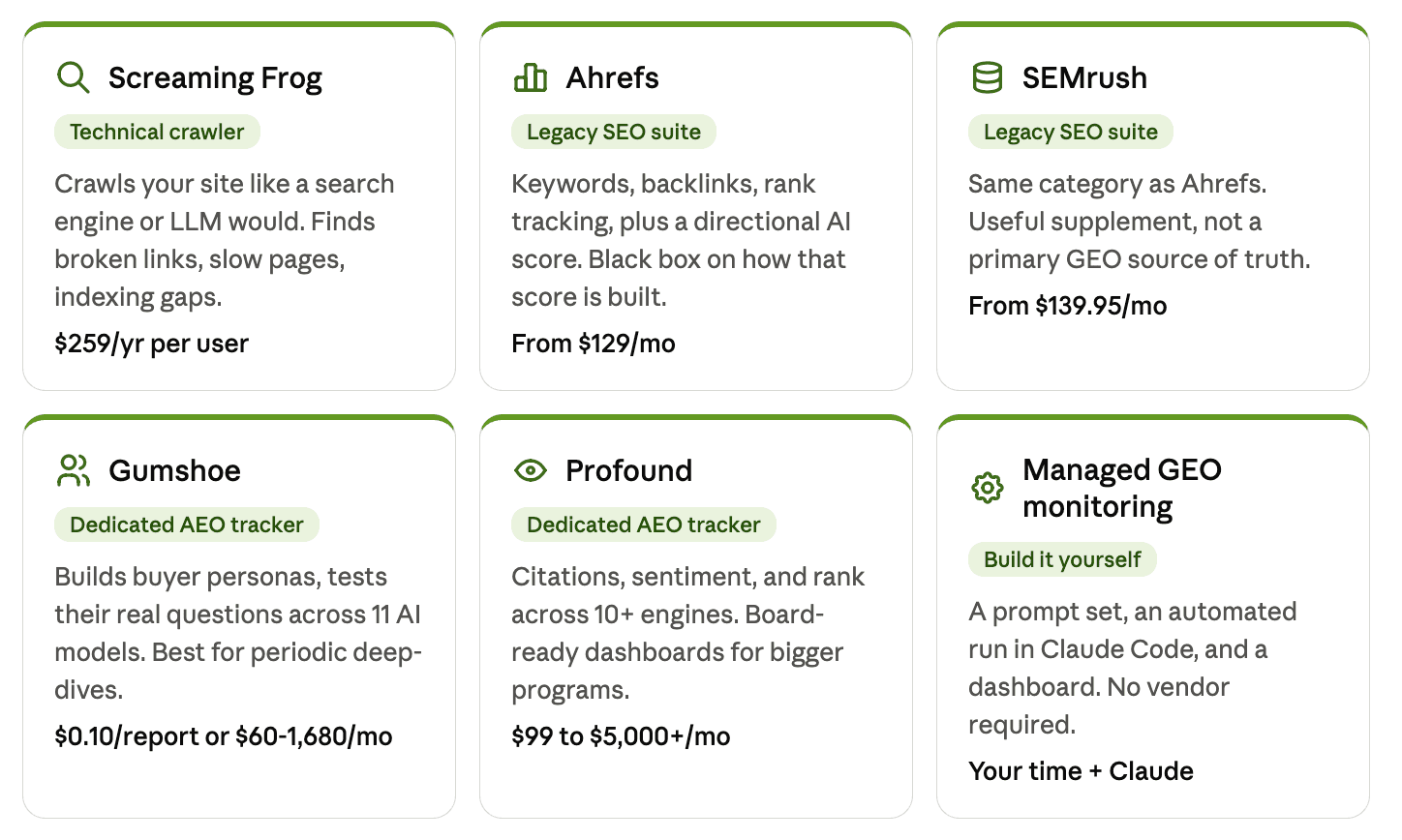
This section breaks down each of these high-trust monitoring platforms by the value it provides and fit for team size.
Screaming Frog
What it is: A desktop crawler that scans your site the way a search engine or LLM would, surfacing broken links, slow pages, and indexing issues.
Category: Technical crawler
What it actually does:
- Crawls every internal link and flags broken pages, redirects, and server errors
- Surfaces missing/duplicate metadata and indexation gaps
- Exports crawl data for custom technical SEO dashboards
Pricing: Free for sites under 500 URLs. $259/year per user for unlimited crawling (volume discounts at 5+ licenses). No monthly subscription.
Best for: Any team running a GEO program, regardless of size. This is foundational, not optional.
Watch out for: Dated interface, real learning curve. No keyword research, backlink data, or LLM citation tracking — it only does the technical layer.
Ahrefs
What it is: A legacy all-in-one SEO suite that’s added surface-level AI Overview and “AI score” tracking on top of its core keyword/backlink toolset.
Category: Legacy SEO suite
What it actually does:
- Keyword research, rank tracking, backlink analysis
- Site audit / technical health scoring
- Directional AI Overview visibility reporting
Pricing: Lite plan around $129/month; higher tiers scale with keyword and crawl volume.
Best for: Teams that already rely on it for core SEO and want a directional read on AI visibility without a dedicated tool yet.
Watch out for: The “AI score” is a black box. Most teams can’t say what actually feeds it, which makes it easy to celebrate a number moving for the wrong reason. Don’t treat it as a substitute for real citation tracking.
SEMrush
What it is: Same category as Ahrefs — a broad SEO platform with an AI visibility layer bolted on.
Category: Legacy SEO suite
What it actually does:
- Keyword and competitive research, site audit
- Traffic and ranking analytics
- Basic AI Overview / AI visibility scoring
Pricing: Pro plan around $139.95/month; scales up from there.
Best for: Teams that already run their SEO reporting through it and want one more data point layered in, not a primary GEO source.
Watch out for: Same black-box scoring issue as Ahrefs. Useful as a supplement, not a source of truth for citation quality or sentiment.
Gumshoe
What it is: A persona-driven AI visibility tracker that builds realistic buyer personas and runs their actual questions through multiple AI models to see how your brand shows up.
Category: Dedicated AEO tracker
What it actually does:
- Tracks brand mentions across 11 AI models (ChatGPT, Gemini, Claude, Perplexity, DeepSeek, and more)
- Builds AI-inferred buyer personas and tests real buyer questions against them
- Shows competitive rank, model-by-model visibility, and top cited sources
Pricing: Pay-per-report from $0.10/conversation (3 free reports to start), or subscription tiers roughly $60–224/month for weekly monitoring, up to $450–1,680/month for daily tracking across more engines.
Best for: Teams with specific, well-defined buyer personas who want strategic, periodic deep-dives rather than daily automated monitoring — strong for a one-off audit or a new-client pitch.
Watch out for: No sentiment tracking, no built-in traffic attribution. Pricing scales unpredictably if you’re monitoring at high frequency across many prompts.
Profound
What it is: An enterprise-grade AI answer intelligence platform built for teams that need reporting depth and stakeholder-ready dashboards.
Category: Dedicated AEO tracker
What it actually does:
- Tracks citations, sentiment, ranking, and competitive presence across 10+ AI engines
- Agent Analytics shows how your site is being crawled and interpreted by AI
- Prompt Volumes shows actual demand data behind the queries driving your visibility
Pricing: Starter around $99/month (ChatGPT only, 50 prompts). Growth around $399/month (3 engines, 100 prompts). Enterprise is custom, commonly $2,000–5,000+/month.
Best for: Larger programs and enterprise brands that need board-level reporting, multi-platform coverage, and a defensible data layer to justify budget.
Watch out for: Prompt limits feel restrictive fast if you want broader testing. The jump from Growth to Enterprise is steep, and Enterprise pricing isn’t published — get it in writing before you budget around it.
Something Different… Managed GEO Monitoring
Many teams assume GEO monitoring has to come from an external tool or service.
That’s not actually true. Plenty of teams build their own monitoring suite in-house to dig deeper into their program than any off-the-shelf tracker allows.
Best for: Teams with a program mature enough to know exactly what they want tracked, and some technical resource (a developer, an analyst, or just comfort with AI tools) to set it up. Not a day-one move — most teams should start with the first two tiers above and graduate into this once they’ve outgrown what those tools show them.
How to build it — a starting point:
- Define your fixed prompt set first. 100–200 real buyer-language prompts, not just keyword variations. This is the input everything else depends on.
- Use Claude Code (or the Claude API) to automate the runs. Set up a script that sends your prompt set to the models you care about on a schedule — weekly is usually enough to start.
- Log the output in a simple structured format. For each prompt: was the brand mentioned, where did it rank in the answer, what was the sentiment, what sources got cited. A spreadsheet or lightweight database works fine at this stage.
- Build a dashboard on top of it. Claude can generate a simple visualization (trend lines, share-of-voice by competitor) directly from that data so you’re not stuck reading raw exports.
- Re-run on a fixed cadence and diff the results. The value isn’t the first snapshot, it’s watching the trend line move as you make changes.
Start small: one model, one prompt set, one month of data, before trying to replicate what a full platform does across ten engines.
2/ The First 90 Days of GEO
We studied the first 90 days of how dozens of high-growth brands started their GEO programs and scaled quickly to see results: the planning, the strategy, and operationalizing it all.
Quickest GEO Win: Setting Up Monitoring + Measurement
Everyone wants to talk about the sexy stuff first: posting on Reddit, 10x-ing search traffic. But none of it means anything if you can’t tell whether it’s working.
Measurement is the boring ingredient nobody wants to prep, but it’s the one that makes every other ingredient taste like something. Skip it, and you’re not running a GEO program — you’re just guessing louder.
You’re Tracking Your GEO Wrong
Ask most marketing teams how their GEO program is performing and they’ll point you to one number: an “AI score” from a tool like Ahrefs or SEMrush.
Ask them how that score is calculated… crickets.
A single black-box number feels like measurement, but it isn’t. It’s a proxy standing in for a dozen things you haven’t actually looked at: which prompts you’re tested against, which platforms are included, whether a citation counts the same as a mention, whether sentiment is factored in at all.
This gets worse when you realize what these tools aren’t measuring.
Only about 1% of users click a link inside an AI Overview.
If your only lens on GEO is click-through traffic, you’re straining to see a signal that was never designed to be visible in the first place.
Meanwhile, brands that are cited inside an AI Overview earn roughly 35% more organic clicks than brands that aren’t cited at all on the same query. That signal, whether your brand or product shows up as the solution, matters, because it shapes the buyer journey.
The fix is changing the dashboard, and changing the question. Instead of “what’s our AI score,” ask: where are we cited, what are we cited for, and is that the story we want being told about us.
What Metrics Should You Actually Watch
Attributed site traffic is table stakes.
Tag your AI referrals with UTMs, pull them into GA4, and you’ll have a baseline. But that’s the last mile of a much longer story, and if you stop there you’re missing almost everything upstream of it.
Here’s the scorecard your team needs to be working off of, and why:
- Citation rate. Out of a defined set of prompts your buyers would actually ask, what percentage return you as an answer? This is your foundational number, the one everything else sits on top of.
- Share of voice. When you are cited, are you first, or fifth, alongside three competitors? Being technically present and being the recommended answer are two different outcomes, and only one of them moves revenue.
- Sentiment and accuracy. Being cited is not automatically a win. An LLM can cite you as an expert in the wrong thing, or as a cautionary example instead of a recommendation. A rising citation count with the wrong sentiment underneath it isn’t progress — it’s a slow-motion problem.
- Prominence. Are you the main answer, or a footnote three lines down? Position inside the answer changes how much weight a reader gives you, even when they never click through.
Why is any of this worth the effort?
AI-referred visitors convert somewhere between 2.3x and 4.4x better than standard organic traffic. A handful of the right citations, to the right audience, can outperform a much larger volume of the wrong ones.
How to Set Up Tracking
There are a dozen tools promising to monitor your GEO performance right now. Not all of them are measuring the same layer, and almost none of them are sized for the same program.
Here’s how they actually break down:
| Tool type | What it’s strong at | Where it falls short | Best fit |
|---|---|---|---|
| Technical SEO crawler (e.g. Screaming Frog–based dashboard) | Crawl depth, indexation, site speed, the foundational plumbing | Doesn’t touch LLM citation behavior at all | Every program, non-negotiable first layer |
| Legacy SEO suites (Ahrefs, SEMrush) | Directional AI Overview visibility, familiar reporting | The “AI score” black-box problem; not built for true AEO tracking | Useful supplement, not a primary source of truth |
| Dedicated AEO/GEO trackers (e.g. Gumshoe, Profound) | Citation tracking across ChatGPT, Claude, Perplexity, Google AI Overviews | Still requires a real prompt set to be useful — garbage prompts in, garbage signal out | Small to mid-size programs |
| Managed/service-tier audits | Large-scale prompt testing (75–100+ queries), executive-ready reporting, competitive share of voice | Cost and lead time; overkill for a lean team | Large programs, board-level reporting |
Don’t make this mistake: manual tracking. Many CMOs start their tracking program by testing 5–10 prompts manually in ChatGPT and calling it an audit.
That doesn’t work because AI answers are personalized and non-repeatable by design. A handful of prompts tells you one buyer’s journey, but doesn’t speak to the whole buyer journey. To get that, you need somewhere closer to 75–100+ query variations before the signal is statistically meaningful.
Steal this tool stack by marketing team size:
- Small program: the technical dashboard, plus one lightweight AEO tracker (Gumshoe or Profound), plus a manual spot-check of 20–30 prompts monthly.
- Medium program: the same stack, upgraded to a proper 75–100 query audit run monthly for real statistical confidence.
- Large program: managed audit tooling with executive dashboards, tracking share of voice across every major platform at once, reported on a cadence your CMO can actually use in a board deck.
Time to Start Benchmarking: Here’s How
Before you touch a single page, take the baseline:
- Define a fixed prompt set, 100 to 200 buyer-language prompts your actual customers would ask, and test it before you make a single change.
- Track it monthly as a trend line. Without that, every improvement you make later is a claim you can’t back up.
- Define the ROI you need to know vs. can’t prove. A useful starting formula: citation rate × prompt volume × click-through rate × conversion rate gives you a modeled impact number. But standard analytics setups only capture an estimated 10–20% of GEO’s true financial return — the rest sits in influenced pipeline and brand lift that doesn’t show up in a last-click report.
- Keep expectations grounded. Some of the most aggressively documented case studies show 17x–31x ROI within a 90-day window in B2B SaaS and cybersecurity, but results vary by vertical.
Keep a Pulse on How GEO Grows
Once the baseline exists, measurement stops being a one-time project and becomes an operating rhythm: monthly citation trend lines, quarterly share-of-voice reviews against your named competitors.
This is the infrastructure that lets you start placing real bets — testing a schema change, ungating one gated asset, building a structured comparison page — and actually knowing whether it moved anything.
The easy wins get harder every quarter. Structured data used to deliver a 20–40% lift in visibility on its own.
Now that everyone’s doing it, that same tactic often delivers closer to 5–10%, compounding with whatever else you’re layering on top.
Growth here isn’t one big unlock, it’s stacking small, provable wins on top of a baseline you trust.
A good next test to run off this baseline: structured, query-focused content sees roughly a 31% higher citation rate than unstructured pages. That’s a concrete, measurable lever to point your first bet at.
In Summary: How to Make It Work
It all comes back to the same principle: you can’t manage what you can’t see, and in GEO, most teams are looking at the wrong instrument panel entirely. Here’s what that looks like when it’s working:
- Measure citation quality, not just citation volume. A rising number means nothing if you can’t say what you’re being cited for.
- Build your prompt set before you build anything else. 100–200 real buyer-language prompts, tested monthly, is your foundation.
- Match your tooling to your program size. A small team doesn’t need enterprise audit tooling, and a large program can’t run on manual spot checks.
- Benchmark before you touch anything. The baseline isn’t a delay tactic, it’s the only thing that lets you prove impact later.
- Report ROI as a range, not a promise. Conservative, base, aggressive. Stakeholders trust honest uncertainty more than false precision.
- Treat measurement as a rhythm, not a report. Monthly trend lines, quarterly competitive reviews — the compounding happens in the tracking, the same way it happens in the tactics.
Which Prompt to Bet on to Convert 2x
The way you prompt in ChatGPT isn’t the way you Google something.
That buying psychology distinction should tell you everything about how to bet on GEO, and which prompts will win new customers.
Keywords Are Getting Longer
Type a question into a search bar and old habits kick in. Three words, maybe four.
Type the same question into a chat window and something different happens. You explain yourself. You add context. You ask the way you’d ask a person.
That shift shows in the data: average prompt length for search-enabled ChatGPT queries nearly doubled year-over-year, climbing from 4.7 words to 8.7 words between early 2025 and early 2026.
A separate analysis of over 20 million query fan-outs found the same doubling pattern happen in just four months, uniform across countries and languages (Peec AI).
An estimated 70% of ChatGPT prompts don’t match any traditional keyword in GEO database monitoring tools.
The more someone uses a prompting interface, the more they learn that specificity is what gets them a useful answer back. So they add the detail. They name the constraint. They describe the exact situation they’re in.
The implication is bigger than it sounds. The “keyword” of 2026 isn’t really a keyword anymore. It’s a mini-brief. And if your GEO strategy is still built around betting on head terms, you’re betting on a shrinking share of how people are actually asking.
How Do I Turn SEO Keywords into GEO Wins?
Here’s one framework worth building around: keyword + buyer journey stage + objection = GEO bet.
A keyword alone tells you what someone’s interested in, but it doesn’t tell you where they are in the decision or what’s making them hesitate.
This matters because an SEO keyword was built to match a search index. It was optimized to sit inside a title tag and get picked up by a crawler. A GEO bet has to do something different: it has to match a conversation, and sit inside the story of the buyer. Those are not the same design problem, even when they start from the same word.
Case Study: Sneaker Brand
Take a sneaker brand and look at what its top five SEO keywords might actually be:
- Best running shoes for flat feet
- Waterproof sneakers
- Sneakers for wide feet
- Sustainable sneakers
- Sneakers for plantar fasciitis
Each of those probably already maps to a blog post — a buying guide, a “best of” roundup, a product comparison page. That’s the SEO layer, and it’s doing its job.
But these wouldn’t work for GEO as-is: “Sneakers for wide feet” sits at the solution-aware stage — the buyer knows shoes exist for their problem, they’re comparing options.
To turn this into a GEO keyword, combine the keyword “wide feet” and “sneakers” with a stage in the buying journey and the objection. This is where it comes in handy to know your audience. Here’s an example:
- Keyword: Wide feet sneakers
- Buyer journey stage: Problem aware (wide feet that need protection)
- Objection: Without needing to size up
AI is your friend here. Develop prompts that might come from this combination, like:
- “What sneakers are made for wide feet that still protect your toes? I don’t want to buy a bigger size.”
- “My feet are wide and always hurt in regular sneakers. Is there a shoe that fits wide without sizing up?”
- “Best wide-foot sneakers for foot pain and protection in true-to-size widths?”
- “How do I find sneakers that accommodate wide feet without going up a shoe size?”
- “Do any sneaker brands make true wide-width shoes so people with wide feet don’t have to size up?”
Do this across all five keywords and you get five distinct bets, each anchored to a stage and an objection instead of just a topic. That’s the difference between a keyword list and a GEO strategy. It’s worth the extra step.
Where to Look for GEO Prompts
You can’t just log into a dashboard and see what people are asking ChatGPT. There’s no Search Console for LLMs. The queries happen inside a black box, and the model isn’t handing you a report.
What’s the workaround? Looking at organic conversations with similar signals. Some starting places:
- Reddit threads
- YouTube comments and questions
- Organic social replies
- Product reviews (for your product, or for competitors)
These are where the raw, unpolished language people actually use lives — not the keyword someone would type into a search bar, but the way they’d actually phrase a question or complaint to another human.
An estimated 97.4% of AI citations pull from non-Tier-1 earned media: Reddit threads, niche YouTube videos, and long-tail social content, not traditional publishers. If that’s where the models are pulling from, that’s where the real prompt language is forming too.
AI Workflow: Automating Scraping Weekly
Set up a lightweight AI job that runs every Monday. It pulls new Reddit threads matching a defined set of brand and category terms, whatever’s relevant to your space.
Here’s how to build it:
- Lock a term list: brand, product, and category terms in a simple config file
- Pull threads weekly via Reddit’s API, scoped to the last 7 days
- Filter for relevance with a quick keyword pass, then a Claude check to kill false positives
- Summarize with Claude: topic, key phrases, sentiment (positive/negative/neutral)
- Roll it into one digest, grouped by term, so patterns jump out
- Log it weekly so sentiment trends show up over time, not just a single snapshot
- Drop it in Slack every Monday morning, cron job, no dashboard to remember
This is really an extension of the Managed GEO Monitoring approach covered earlier: same idea, same Claude Code build, just pointed at a different input source.
I Have 25+ Prompts, Now What?
Your GEO program is only as strategic as the bets you place from it.
Many CMOs starting a program like this direct their attention to every prompt, which actually minimizes the impact. Here’s how the best teams aim for GEO:
3:1:1 Tiered Framework — sort every prompt into one of three tiers:
- Tier 1, high intent, easy win. Specific, objection-heavy prompts where you already have relevant content and the competition is light. These are the fastest bets you can place, and they’re the ones that prove the program is working early, even if the individual volume looks small.
- Tier 2, high intent, medium-to-hard win. The buyer is just as close to converting, but a competitor is already fighting for the same citation, or your existing content doesn’t fully answer the objection yet. These require a real content investment, not a quick edit, and should be sequenced right behind your Tier 1 wins.
- Tier 3, low intent, halo effect. Broader, earlier-funnel prompts that won’t convert directly but build the topical authority an LLM needs to trust you on the Tier 1 and Tier 2 prompts. These won’t show up in a direct ROI line, but they make the other two tiers work better over time.
Roughly 66% of GEO time and budget goes to Tier 1: high impact, low lift. The remaining third splits evenly across Tier 2 and Tier 3, roughly 17% each.
This isn’t an arbitrary ratio. It mirrors the logic of the tiers themselves. Tier 1 gets the majority of the resourcing because the return is fastest and most provable — the kind of thing you can point to when someone asks if the program is working. Tier 2 and Tier 3 are both longer-horizon bets, so they share what’s left rather than one quietly crowding out the other.
Expect results in 90 days. Set this expectation before the first sprint starts: most brands see measurable movement on Tier 1 citation rates around the 90-day mark. That tracks with the monthly audit cadence from the measurement framework covered earlier — roughly three read-outs before you can honestly call a Tier 1 bet a win or a miss.
If someone tells you they saw results faster than that, one of two things is probably true. Either it wasn’t really a Tier 1 bet, it was an easier win wearing a Tier 1 label. Or what moved was a visibility metric, not an actual citation-quality metric. Neither is the win it looks like on a slide.
Running Your First Sprint
Put it together and a first sprint looks like this:
- Three Tier 1 bets, fast and provable, carrying most of the budget.
- One Tier 2 bet, chosen only after it passes the share-of-voice and sentiment check.
- One Tier 3 bet, the halo play that supports everything else.
Scale at that ratio. Remember, it’s hard to measure GEO conversion power truly until 90 days in. You might see early signal that dwindles if it doesn’t move the needle on the buyer journey, or vice versa.
Who’s the Team to Get This Done?
This section breaks down how to re-tool your team with a GEO superpower: where there’s overlap with search, and where you need net-new headcount.
You Probably Already Know Most of This Team
GEO isn’t a new department. It’s a new adjustment to a department you already built.
Roughly 70% of lift on GEO is actually SEO overlap.
Same content, same technical foundation, same signals models are pulling from. What’s different is the last mile: structuring for citation instead of just ranking.
Look at the team you already have:
- SEO lead — owns strategy and roadmap
- Content strategist — briefs and QAs the content itself
- Analytics — tracks rankings, traffic, now citations
- Technical SEO — site health, schema, crawlability
- Paid media (adjacent) — keyword and funnel overlap
None of these roles need to be replaced. What’s missing is bandwidth: one person dedicated to executing the GEO layer on top of what already exists.
Do you bring in an agency? Depends on what’s already running.
If you have an agency on paid or SEO: GEO is a natural scope extension. The relationship exists, the context exists, the extension is cheap. But ask directly: has this agency ever built or maintained lightweight AI tooling before? Most haven’t. That’s not a knock, it’s just not their build.
If you don’t have an agency: this is an in-house build by default. The risk isn’t capability, it’s ownership. Without a dedicated person, GEO becomes the thing that gets touched once a month instead of once a week.
Here’s the timing case for building in-house first, regardless: GEO’s ROI shows up on a lag. The halo effect, citations influencing brand consideration before they influence direct conversion, takes time to surface in the data. Handing this off before you’ve seen that curve means handing it off before you know what’s actually working. Build the muscle first. Hand off second, if at all.
GEO Programs Die From One Thing: No Owner
Most SEO programs scaled because one person owned it and was accountable for the number going up. Same rule applies here, and it’s the single biggest predictor of whether a GEO program survives past quarter one.
Self-assessment:
- Is there one name attached to this program, or a committee?
- If citation share dropped 20% next month, whose job is it to notice?
- Is that person’s performance review tied to this number?
If you can’t answer those three cleanly, you don’t have a program. You have a project that will quietly die in Q3.
What’s the Profile for a GEO Hire?
Our team at GrowthAssistant has placed 6 profiles like this in the past month. Two archetypes:
The Technical Expert lives inside the infrastructure: schema, crawlability, maintaining monitoring tools, understanding how models actually source and weight information. Right fit when your content is solid but your foundation isn’t feeding the machines correctly.
The Community Manager lives inside the conversation: Reddit, forums, review sites, the raw material citations get built from before they ever become citations. Understands brand voice well enough to separate real signal from background noise. Right fit when your infrastructure is fine but nobody’s watching where the narrative is actually forming.
Most teams lean toward one, not both, at least at first. It depends where AI is scraping your content more. For DTC, that’s likely community; for B2B or companies with a less mature web presence, that might be inside the technical elements.
Hiring for the Execution Layer
This is the execution layer, not a new department.
A dedicated Growth Assistant can own the weekly digest end to end: monitor the build, flag what’s worth escalating, sit inside Slack with the rest of the team. Same accountability structure as an internal hire, at a fraction of US hiring cost, without adding agency overhead or waiting on a scope renegotiation.
It’s not a new role in the org chart. It’s the “someone dedicated to execution” the team was already missing.
3/ The Execution Behind Appearing on ChatGPT + Claude
Where your brand needs to play will be unique to you. This section goes channel by channel, hot-or-not style, so you know where your early wins will be.
Technical Page Set-Ups Will Kill Your GEO Program
The unsexy part of GEO matters more than any blog post a content team can write.
The technical side has the power to supercharge both GEO and SEO.
Stop Treating Search Like a Checklist
The old way treated technical search like a chore list: add the meta description, compress the images, submit the sitemap. Check the box, move on, don’t think about it again until the next audit.
That doesn’t work anymore.
Same foundation, but the brands actually showing up on search have a strategy that sits on top of it. When they build pages, it’s not for their brand, it’s for Google, ChatGPT, and Perplexity to trust and cite. The strategic mentality assumes the technical layer is load-bearing for everything you build on top of it, forever.
Bad News… The Technical Setup Matters
GEO doesn’t replace your SEO foundation. It stacks directly on top of it.
The most basic failure point is laughable: whether AI systems can even get into your site.
Roughly 27% of B2B sites are accidentally blocking major AI crawlers via CDN-level rules, often without anyone realizing it. And the exposure is growing, not shrinking: twenty-five percent of the top 1,000 websites now block GPTBot, up from just 5%.
The stakes for getting this right are real. Some fast facts:
- Princeton research shows GEO methods can boost AI visibility by up to 40%.
- For brands starting from low initial visibility, that lift reaches as high as 115%.
- As of mid-2026, bots now generate 57.5% of HTML web traffic, with humans accounting for just 42.5% — the first time automated requests have held the majority.
Stop looking at the technical side like it’s maintenance. It’s strategy. It is the access point everything else depends on, it’s actively getting worse for teams who ignore it, and the upside for teams who fix it is not small.
Case Study: The Sneaker Site That Doesn’t Want to Be Seen
The website is genuinely good: fast checkout, strong product photography, a conversion rate the team is proud of. When people land on the site, they buy.
One problem: the schema markup was never set up to properly label products, name prices, or dictate availability for machine readers.
The marketing team proved that the site could convert, but only for humans who had already found it.
It gets worse. Traditional SEO already takes a hit without clear schema, since no search engine can understand what’s happening on the page. GEO takes a bigger hit, because a model deciding whether to recommend this site over a competitor’s needs to trust, quickly and unambiguously, that this is a real product at a real price with real stock. The site’s invisible to the recommendation entirely.
The lesson: technical gaps cap who’s in the conversation. The site looks fine. It converts fine. Nobody notices the bottleneck until someone goes looking for it specifically, which is exactly why it’s easy to overlook and expensive to leave alone.
How Do I Know If My Technical Element Is Working?
You don’t need to read code to know if this is broken. A few high-level signals worth checking on a regular cadence:
- Are you cited at all, anywhere, for your category? If a direct competitor shows up in AI answers for your exact space and you don’t, that’s a visibility gap, not a content gap, worth investigating before writing another blog post.
- Is your brand described accurately when it does show up? Wrong pricing, discontinued products, or outdated positioning in an AI answer usually points to a technical/schema issue, not a strategy issue.
- Has anyone actually checked your access settings this year? If the honest answer is “I don’t know who owns that,” that’s your answer. Most of these blocks came from a CDN setting, an outdated robots.txt file, or a site built in a way bots can’t read — not a deliberate choice anyone made.
- Do your highest-value pages look the same to a bot as they do to a human? If your product pages rely heavily on JavaScript to load the actual content, ask your team directly whether that content is visible without it running.
None of this requires touching a line of code yourself. It requires asking your team pointed questions and noticing if nobody has a confident answer.
AI Workflow: “Is My Site Set Up Right?”
A lightweight way to sanity-check this without waiting on a full technical audit:
- Set up a recurring Claude Code job that pulls your site’s robots.txt directly and checks it against the current list of major AI crawler user-agents (GPTBot, ClaudeBot, PerplexityBot, Google-Extended, and others).
- Have it fetch a handful of your highest-priority pages with JavaScript disabled, and compare the raw HTML to what a human sees in a normal browser. Flag any page where the two don’t match.
- Return a simple report: which crawlers are blocked, where, and which pages might be serving an empty shell to a bot instead of real content.
This isn’t a replacement for a full technical audit. It’s the equivalent of checking your smoke detectors: quick, cheap, and it tells you immediately if something needs a professional look.
If you’d rather skip the custom script, GrowthAssistant’s free GEO Visibility Checker runs this same audit for you in seconds, checking your site against GPTBot, ClaudeBot, PerplexityBot, and the other major AI crawlers to flag exactly where access is blocked.
CMOs: Look Smart. Ask Your Dev Team These Questions Now.
The specific problems worth flagging directly to whoever owns your site’s infrastructure:
- Blocked AI crawlers in robots.txt, whether intentional or not. Read every line as if you were the bot trying to get in.
- CDN-level blocks that override robots.txt entirely. Log into whatever sits in front of the site (Cloudflare or similar) and check for a “block AI scrapers” toggle — this overrides everything else and is often switched on by default.
- Client-side rendering hiding real content from crawlers that don’t execute JavaScript. View page source on key pages and confirm the actual content is present in the raw HTML, not just rendered after load.
- Missing or broken schema markup on product, pricing, and FAQ content — the structured labels that tell a machine reader exactly what it’s looking at.
- Conflating training-bot blocks with search-bot blocks. These are separate systems with separate user-agents. Blocking a training bot like GPTBot does not block ChatGPT search, and blocking Google-Extended has zero effect on Google Search rankings. Getting this distinction wrong means either exposing more than intended or accidentally opting out of the exact citations you want.
- No one actually owns this. The most common root cause behind every problem above isn’t a bad decision — it’s that the robots.txt was written by a developer or agency years ago and nobody has opened it since.
The sixth reason is where a Growth Assistant slots in perfectly. Dev and search assistants work your hours and completely own the maintenance, so you can work on site strategy and rank in search.
What People Say About You Matters: Getting AI to Give You Good Reviews
Showing up in a chatbot is a win… except when the chatbot isn’t recommending your product. So how exactly do you ensure you get the best review possible?
Marketing 101: What People Say About You Matters
Being cited isn’t automatically a win. An LLM can cite your brand as the trusted recommendation, or it can cite you as the cautionary tale, and a citation-count dashboard looks exactly the same either way.
Volume tells you almost nothing on its own. Tone is what tells you whether that volume is helping you or quietly working against you.
Reddit carries outsized weight. Reddit is often the single most-cited domain in AI search, ahead of Wikipedia, ahead of YouTube, ahead of anything a brand actually owns, because it’s user-generated and high trust.
A thread full of genuine praise functions like a testimonial, and a model trusts it more than your own marketing copy. A thread full of genuine complaints works the same way in reverse, and it doesn’t take much. A handful of people piling onto one bad experience reads as consensus, and consensus is exactly what these models are built to extract and repeat back.
This is a revenue problem, not just a reputation one. Here’s the part worth sitting with: your SEO can be flawless, your content team can be shipping every single week, and you can still lose the sale — not because your website failed at anything, but because of a Reddit review you weren’t in the room for.
The buyer doesn’t reach your funnel to tell you why they didn’t convert. They just don’t show up.
Case Study: The Thread That Outranked the Brand
A pet food brand had a full search team, but wasn’t seeing any conversions from GEO.
Prompted in ChatGPT or Claude about their SKUs of pet food, the output would highlight negative aspects of their product.
The culprit? A negative Reddit thread had been sitting at the second search result for their own brand name for over a year. Every AI answer about them was pulling straight from it.
The fix was easy. They joined it:
- Ran an AMA in that same thread
- Brought in a real expert to answer real, unscripted questions live about pet foods, with subtle brand mentions
- Let genuine customers add their own experience underneath in the comments — no takedown request, no new landing page built to compete with it
Within twenty-four hours, the thread that had been quietly suppressing them for over a year was displaced in Google’s own results. Shortly after, it dropped out of the AI citations pulling from it too.
The takeaway: reputation management and GEO are the same job now. The fix wasn’t more content. It was genuine presence in the exact place the conversation was already happening.
How to Measure and Monitor Sentiment?
Sentiment is one of three things that make up real citation quality. But because it’s difficult to track, most teams just track share of voice.
The danger is reporting a GEO win when the information being output is negative or encourages consumers to purchase your competitor.
AI-referred visitors convert 3x better than standard organic traffic. A handful of the right citations, with the right sentiment, can outperform a much bigger pile of citations that are technically present but tonally weak.
The build. Here’s a simple, lightweight AI job worth setting up:
- Set the terms. Define a list of brand and category terms worth tracking, whatever’s relevant to your space.
- Run it weekly. A lightweight AI job pulls new Reddit threads matching those terms every Monday.
- Skip the raw dump. Instead of handing back full threads, it returns a short digest for each one: what the thread was about and the actual phrases people used.
- Add the sentiment read. Positive, negative, or neutral — this is what makes it useful instead of just noisy, tracking whether the conversation is trending warmer or colder over time, not just how much of it there is.
Sentiment as a decision filter, not just a tracking metric. The real value of this data is that it becomes a filter for deciding where to spend next.
Before pouring content effort into a contested, high-competition prompt, run a two-part check:
- Share of voice. How often does a competitor already show up versus you across the prompt set?
- Sentiment. When that competitor is cited, is it a genuine recommendation or a lukewarm mention?
The rule that follows is straightforward:
- Low share of voice + strong competitor sentiment → redirect the budget elsewhere. That fight isn’t winnable soon, and no amount of content out-argues real consensus.
- Weak or mixed competitor sentiment → that’s the opening. It’s the gap a sharper piece of content, or a stronger community presence, can actually close.
Once you see it this way, sentiment stops being a report and starts being a live input on where to spend next, the same way you’d treat cost-per-click for any other channel.
High-Growth Edge for GEO: Post on LinkedIn
Go organic before you need it. Any social platform will do.
LinkedIn has one of the highest citation rates of all the social platforms, like Reddit. But a real account, answering real questions in your category, with no pitch attached, builds trust signal long before reviews can take it down.
Keep organic simple. Seeding anonymous accounts to manufacture fake recommendations is a different game entirely, and it’s increasingly detected and banned.
Treat the AMA as a repeatable move, not a one-time fire drill. The pattern is simple: find the thread that’s actually shaping the narrative, show up in it with a real expert and real customers, and let genuine consensus do the work a takedown request never could.
And keep an eye on the gap your own tracking surfaces. The moment a competitor’s sentiment shows up weak or mixed in your Monday digest, that’s the signal to move first, building the content or community presence that closes the gap before they even notice it’s exposed.
Hot or Not: What Earned Channels Are Worth a CMO’s Time
Will your team’s GEO channel be Reddit? Or batching blog content?
This hot-or-not list is inspired by what we’ve heard from dozens of GEO experts, and what’s actually ranking brands.
Hot: Start Here Yesterday
Reddit (for DTC especially) is often the single most-cited domain in AI search, ahead of Wikipedia and YouTube. Generally unfiltered, which is exactly why models trust it.
How to play: Live inside the threads and genuinely answer people’s questions, adding real value. Works best with a real account presence, not a manufactured one built to game GEO.
LinkedIn (for B2B especially) is where B2B vetting and comparison conversations actually happen, mirroring Reddit’s role for DTC. Buyers are reading real posts and real comment threads before they ever talk to sales.
How to play: Show up as actual people on your team, not a brand account. Comment on and engage with the conversations your buyers are already having, don’t just publish at them.
YouTube (niche offerings win here) is named directly alongside Reddit and Wikipedia as a heavily-cited source. Especially strong wherever a category leans tutorial, demo, or comparison-driven.
How to play: Get your product or expertise into the videos already ranking for your money terms, whether that’s your own channel or a creator’s. Depth and demonstration beat polish here.
Review sites (G2, Capterra, Trustpilot — SaaS especially) are the primary citation source for SaaS comparison prompts, the “vs.” questions that make up roughly half of SaaS money prompts. Genuine review volume reads as consensus the same way Reddit does.
How to play: Make leaving a review part of your actual customer journey, not an afterthought. A steady drip of real reviews beats a burst you had to ask for.
Warm: Make These Second Priorities
PR / “best of” listicles have real impact, but only where a brand has thin owned content or third-party presence. Where it matters, it matters a lot; where a brand already has strong product and category pages, it barely moves the needle.
How to play: Identify the specific listicles a model is already citing for your category, then pursue real outreach to the actual editor. Skip the self-published “best of” list — ranking yourself works briefly and risks the model citing your own comparison as evidence for a competitor.
Wikipedia is heavily cited in general, but mostly outside a brand’s direct control to influence. Functions more as a background trust signal than an active channel you can run plays on.
How to play: Keep any existing page accurate and current. Don’t force a presence here, earn it through the same third-party credibility that gets you cited elsewhere.
Quora follows the same mechanics as Reddit, and is always mentioned as a companion to it, never called out as carrying Reddit’s weight on its own.
How to play: Treat it as a secondary version of the Reddit playbook — genuine answers, real account presence, lower priority than Reddit itself.
Blog content is still necessary as foundational infrastructure, but the page alone doesn’t compete with a live conversation happening in a place a model already trusts more. Passage-level extraction now matters more than the page as a whole.
How to play: Structure for extraction — clear definitions, direct answers, hub-and-spoke topic coverage, not narrative build-up. Match or beat the depth of whatever’s already winning the citation.
Cold: Low-Impact Channels
Self-referencing “best of” listicles. Publishing your own ranked list and putting yourself first works briefly, since a model cites it like any other listicle. The catch: some AI systems have started recommending the competitors named inside your own list instead of you.
How to play instead: Skip the self-published ranking. Identify the listicles a model is already citing for your category and earn real placement inside those instead.
Bulk AI content blasts. Publishing volume for volume’s sake, hoping something eventually gets extracted. AI-written content can read as well as human content now, but it still needs a real editorial pass to actually earn a citation.
How to play instead: Fewer pages, deeper coverage. Match or beat the depth of whatever’s already winning for a term, then get a human to shape it for extraction, not just grammar.
Automated PR/backlink outreach at scale. Agent-driven tools that blast personalized-sounding pitches to every listicle in a category, with no human reviewing any individual pitch. It might land a placement here and there.
How to play instead: Real outreach to a real editor who covers the beat. One relationship built carefully outlasts a hundred pitches that could cost you the relationship entirely.
Guaranteed visibility claims. Any vendor promising fixed placement across all major AI engines. The signal itself is unstable — the same prompt run three times can return three different answers, so no one can honestly guarantee a repeatable outcome.
How to play instead: Track trend lines over weeks, not single snapshots. Treat visibility as a range to move, not a number to lock in.
It’s Time to Start Building the Team So Your Brand Shows Up
Velocity is the strategy. But that requires a team built to sustain it. We place the SEO, GEO, and content writing assistants behind the fastest-growing search programs.
If measurement is where you’re starting, pairing this GEO tracking framework with a broader marketing dashboard keeps citation rate, share of voice, and sentiment next to the rest of your KPIs instead of living in a separate tool nobody checks.
And if your team is exploring how far Claude can go inside your day-to-day marketing workflows, beyond the monitoring builds covered above, see how other teams are using Claude for Marketers.
This same AI-fluency shows up across the rest of the funnel too. If you’re rethinking how AI fits into outbound and lifecycle marketing more broadly, the ecosystem-based approach to AI marketing is a useful next read.




.svg)